Bottom line. Improving customer loyalty in 2026 comes down to personalization architecture. The brands compounding customer lifetime value run loyalty programs that segment loyal customers beyond spend, react to customer behavior in real time, and feed first-party customer data back into every channel. The brands stuck still treat the loyalty program as a discount engine bolted onto the checkout page.
This guide covers what personalized customer experiences look like inside a loyalty program, why most personalization efforts stall, the 12 strategies to improve customer loyalty that move the metrics, and three Open Loyalty customers (limango, EQUIVA, Dietly) hitting numbers that prove the model works.
Picture the loyalty rewards email a member opened this morning. It congratulated them on hitting Silver tier, then recommended the exact product they bought last week. That mismatch is the customer experience problem.
Customer expectations have moved. 71% of consumers now expect personalized interactions, and 76% report frustration when those interactions are missed, according to McKinsey.
Loyalty programs sit right in the middle of that gap. Improving customer loyalty in this market starts with rebuilding the loyalty program around member context, customer behavior, and customer feedback (in that order).
Customer loyalty is the repeat preference a customer shows for one brand over the alternatives. Loyalty programs are the mechanic that earn it; brand loyalty is the outcome.
The loyalty program has to recognize the member, understand their customer needs, and adapt offers accordingly. According to Open Loyalty's emotional loyalty research, 72% of consumers only engage with personalized messaging. Generic broadcast loyalty trains existing customers to ignore your brand.
"But isn't a points program already a loyalty program?" Well, not when every competitor runs the same one. A points program is a transactional ledger. A personalized loyalty program is a relationship layer that turns satisfied customers into brand advocates and engaged customers into recurring revenue.
The customer loyalty journey runs through four touchpoints: acquisition, first purchase, repeat purchases, and advocacy. Members also move through four lifecycle stages: new, active, at-risk, and loyal.
For new customers, lead with onboarding loyalty rewards tied to declared customer preferences. For active customers, run progress mechanics that encourage repeat purchases. For at-risk members, trigger reactivation flows tuned to your category cycle to lift customer retention. For loyal customers, unlock recognition rewards money cannot buy: early access, surprise drops, and named perks that strengthen customer relationships.
Every stage transition is a trigger event your loyalty program should react to in real time, not in tomorrow's batch.
Brand loyalty lives inside the customer experience. The loyalty program either reinforces that experience or sabotages it.
A points-only rewards program reinforces a transactional relationship. A loyalty program that remembers customer preferences across web, app, and store reinforces a relational one. That shift is how brands build customer loyalty and increase customer satisfaction at the same time. Removing friction from the customer journey across multiple channels is essential; customers prefer simple processes that make customers feel valued.
Each strategy ties back to a layer of personalized loyalty: segmentation, rewards, real-time triggers, zero-party customer data, and omnichannel consistency. Pick the two or three that match where your loyalty program is weakest and pilot them.
Spend tiers (bronze, silver, gold) treat the loyalty program as a revenue ladder and ignore loyal customers who buy infrequently but advocate constantly. Combine transactional, behavioral, and declarative customer data so the segments reflect the full relationship.
Start with three customer segments (high-value spenders, high-value advocates, at-risk loyal customers) and give each a different reward cadence. Dance music brand Q-dance identified its most loyal customers through community behavior, with XP loyalty points linking the two. Open Loyalty's Segments module handles the assignment automatically.
Tier-restricted promotions give VIP customer segments a different catalog than new customers. Dynamic rewards adjust the offer based on member context (last purchase, category interest, lifecycle stage), so the loyalty rewards a member sees feel hand-picked.
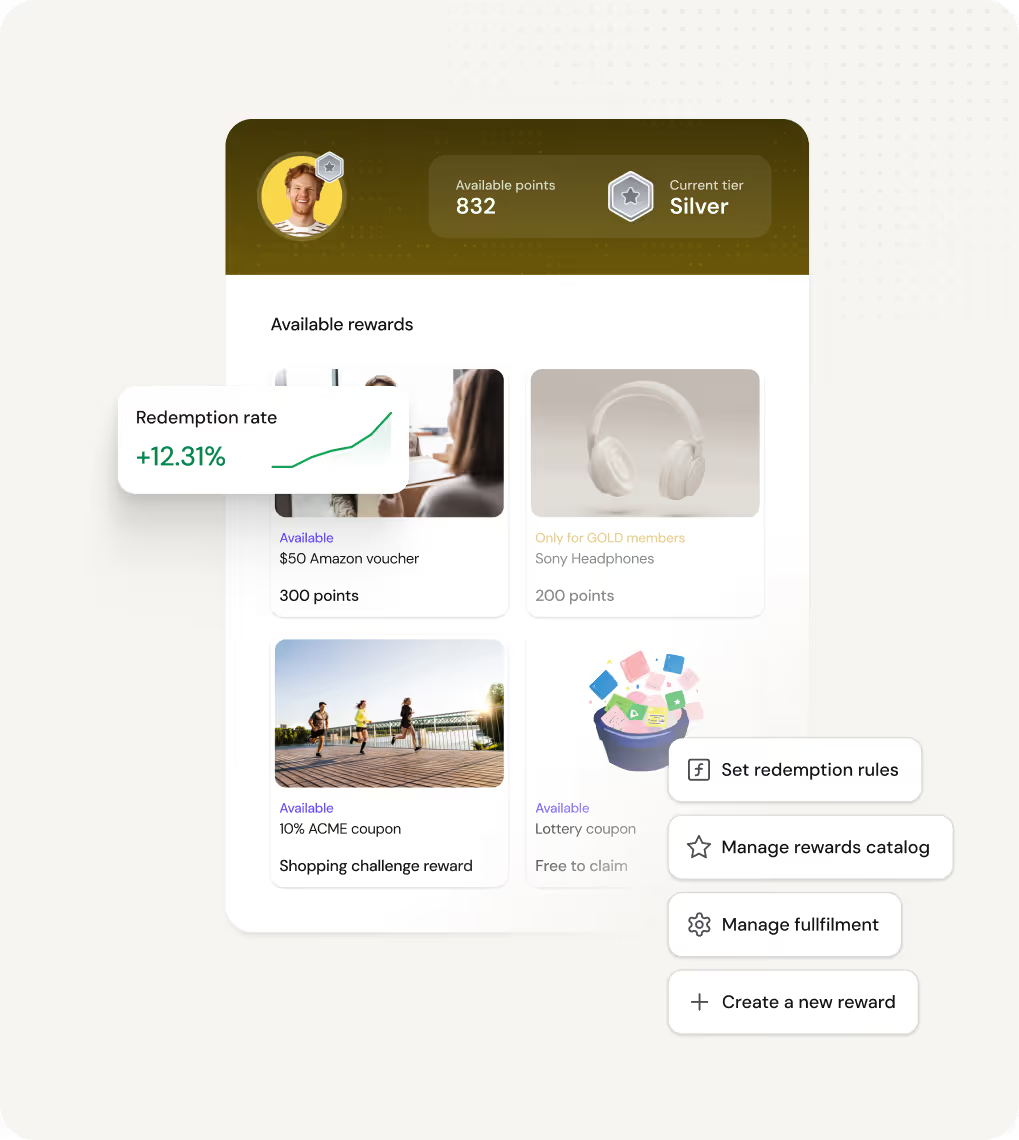
Audit your reward catalog by tier. If your top tier gets the same percentage discount as your bottom one, the tier is the only differentiator. EQUIVA replaced bronze, silver, and gold with "friends, best friends, soulmates" so the tier signaled the relationship. Run tiered loyalty programs where the personalized reward is the tier, not the discount.
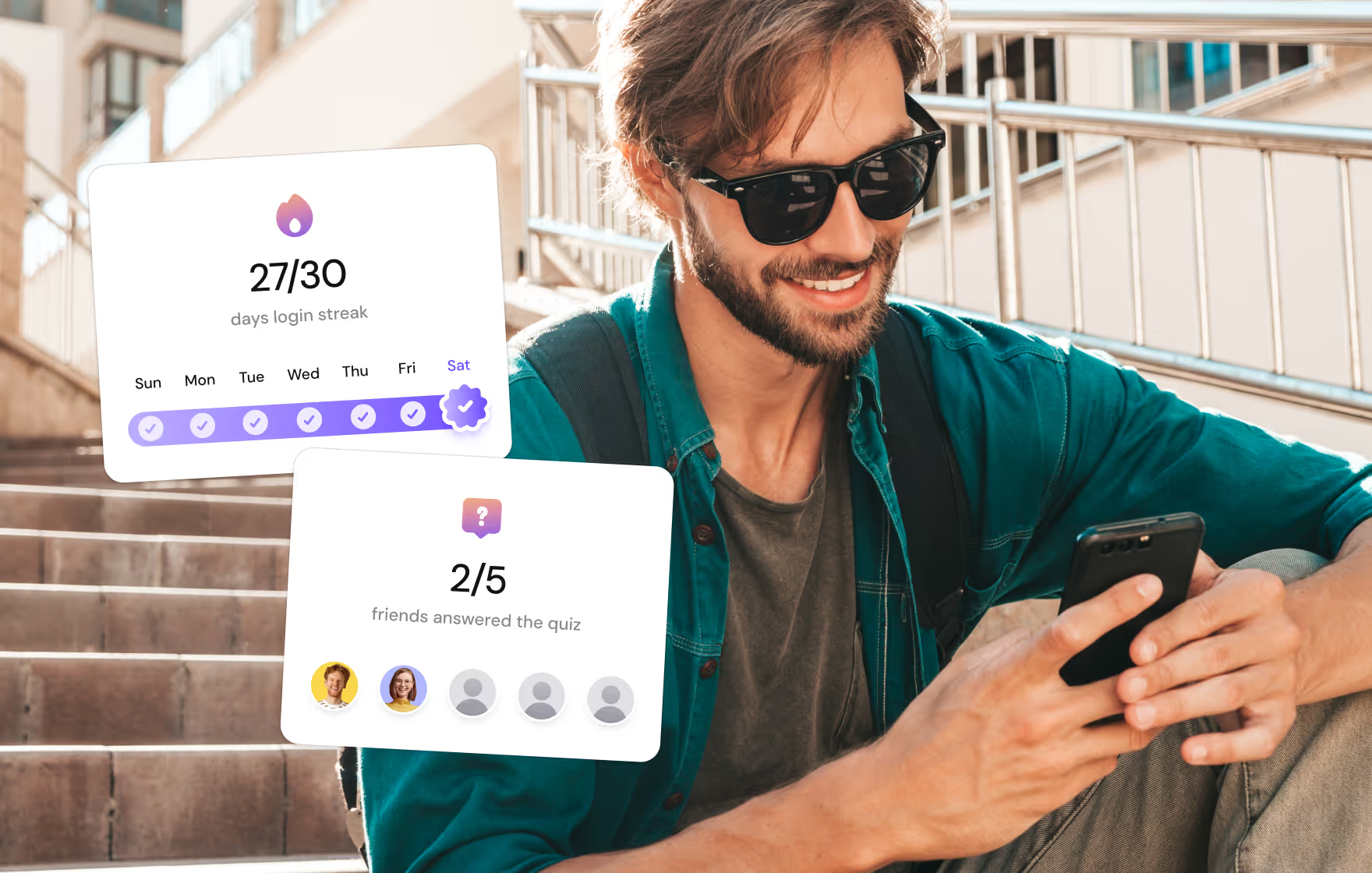
Live progress bars, streak incentives, and limited-time challenges create reasons to return between repeat purchases. None of them works on a batch sync.
Pick one micro-behavior worth celebrating and ship a progress mechanic around it before adding more. Belgian football club Club Brugge rewards fans for arriving 30 minutes before kickoff. The loyalty points hit the app before the match starts; that immediacy shifted matchday attendance by 8%.
Loyal customers will share preferences, sizes, and category interests if there's a reason to. Reward profile completion, quiz answers, and review submissions to deliver personalized experiences that match their actual needs.
Make the data ask explicit and the reward instant. A 50-point credit for completing a preference quiz beats a vague "help us serve you better" prompt every time. Henkel Italy ran the play with receipt uploads: 63,623 members joined and uploaded 24,000+ receipts. Open Loyalty's zero-party data guide walks through the mechanics.
Personalization breaks the moment a member sees 350 loyalty points on the app and 320 in store. The fix is event-driven architecture, not a nightly reconciliation job.
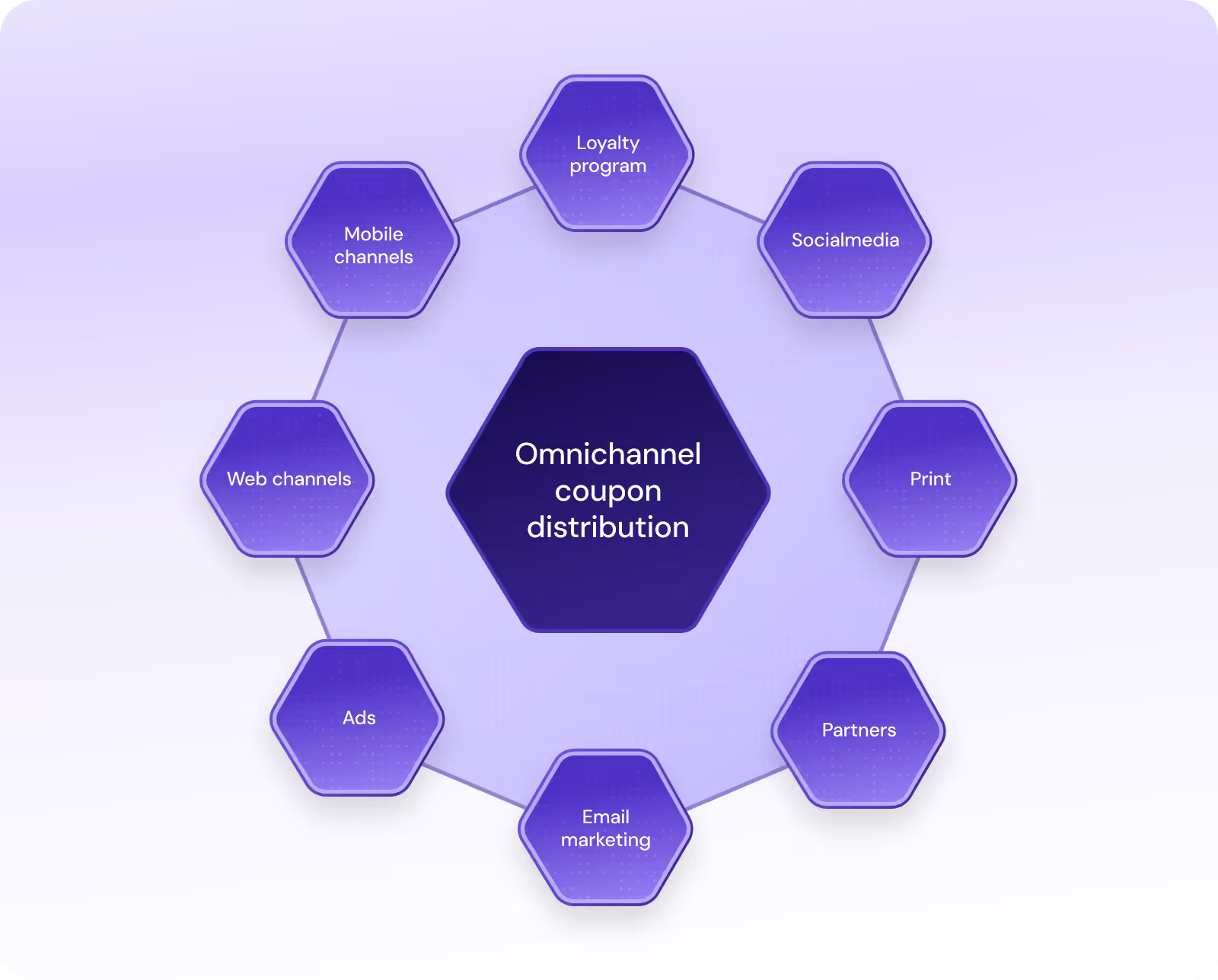
Audit where your loyalty state lives. If it's "four places that sync overnight," your personalization ceiling is overnight. ALDO runs a digital-only loyalty program with QR enrollment and dynamic offers on a 12-month cycle. Every channel reads the same loyalty state in real time, which also cut 50% of infrastructure cost.
Open Loyalty's Loyalty Program Trends 2026 report found 42.1% of loyalty pros rank gamification a top medium-term mechanic. Gamification only earns engagement when it's tied to specific behaviors that compound the program's goals.
Map each gamified element to one customer behavior the loyalty program needs more of. Avoid badges members earn just by existing. Saudi F&B retailer Ekuep wrapped its Rowad rewards program around gamified mechanics and hit 72.34% direct points redemption (a signal that engaged customers act on loyalty rewards, not just earn and forget).
Use purchase history and segment membership to drive next-best-offer logic from the loyalty layer. Open Loyalty's cross-selling campaigns guide shows how loyalty mechanics power offers delivered through marketing automation.
Use the loyalty layer to flag the offer; let the marketing automation tool deliver it. The split keeps personalization logic in one place and delivery in the channel best suited to it. Mobile payments brand Yoyo lifted average order value by 26% with this pattern, encouraging repeat business per visit.
The same offer with different windows for different customer segments outperforms a uniform 48-hour blast. Time-limited offers build urgency without burning the audience.
Two settings to vary: window length and discount depth. Daily-purchase categories want shorter windows with smaller discounts; considered-purchase categories want longer windows with sharper offers. Tier-aware decay (longer windows for higher tiers, shorter for prospects) is one of the easier wins to ship.
Inactivity windows should match category cycles. Coffee subscriptions are dormant at three weeks; premium fashion at six months.
Sequence the reactivation: a soft nudge first ("here's what's new"), a personalized reward second, an urgency-driven offer third. Digital health platform dacadoo lifted 30-day customer retention 7x and monthly active users 62% by mixing personalized incentives with raffle mechanics tuned to dormancy patterns. Open Loyalty's customer activation playbook covers the rest.
The referrer earns a personalized reward tied to their tier; the new customer gets a welcome offer matched to their channel. Personalized referrals lift both completion rate and the quality of the new sign-up.
Don't make the referrer hunt for the reward. Auto-credit on signup, show progress in the app, and notify both sides when the reward unlocks. Warba Bank in Kuwait built referrals into a wider incentive structure (six points per friend, 1,500 points for a salary transfer) so referrals ladder into deeper financial behaviors and grow the customer base.
Customer loyalty incentive programs that combine predictable mechanics (loyalty points, tiers, tenure rewards) with unpredictable ones (surprise drops, recognition rewards) outperform either alone.
Plan the predictable mechanics first, then layer surprise on top no more than once a quarter. Sephora's Beauty Insider is the textbook reference: predictable point earnings layered with a birthday gift, free shipping for top tiers, and tier-restricted experiences satisfied customers count on every year.
The loyalty program is the cleanest source of first-party customer data in the stack. Pipe customer segments, tier status, and earned-reward signals into the eCommerce site, the email tool, and the mobile push channel.
Start with one channel and one signal. Tier-based homepage banners are the easiest first build because the signal is stable and the channel is already personalized. Push notifications based on streak progress are a good second.
Most personalization efforts fail because customer data cannot move fast enough between systems. The CRM holds member identity, the CDP holds customer segments, the eCommerce platform holds purchase history, the loyalty program holds points and tier state. When those cadences are batch-synced, every personalization effort runs one sync behind reality.
Personalized loyalty programs share four architectural traits regardless of vendor. Any platform decision should be measured against these four boxes.
The loyalty program has to send and receive customer data with every other system in the stack. An API-first design exposes that data through REST endpoints, so marketing automation, eCommerce, mobile apps, and POS systems can read and write against the same source of truth.
A purchase should fire once and trigger every downstream action independently. Points update, tier status updates, the CRM logs it, and marketing automation fires the right notification. That demands a loyalty engine built for high throughput and sub-second response times.
The loyalty program doubles as a data collection layer. Loyal customers complete preferences and submit reviews because they get rewarded for it. That customer data must flow into segmentation and into the CDP, where it powers personalized experiences elsewhere in the stack.
MACH-compliant design lets the loyalty program drop into best-of-breed stacks. Salesforce, HubSpot, Segment, Shopify, Bloomreach, custom POS: all should connect through the same documented API. The benchmark to look for: pre-built connectors that turn multi-week integration projects into multi-day ones.
Open Loyalty was built against those four criteria. The platform exposes numerous REST endpoints and runs at 120 ms average response time and 99.99% uptime, processing roughly 50 million transactions and 800 million loyalty events per year.
Zero-party customer data flows into segmentation and out to the CDP through built-in integrations on the eCommerce industry page. On composability, a documented Bloomreach + Open Loyalty integration completed in under 30 minutes sets the speed benchmark.
Gianfranco Cuzziol, the loyalty strategist Open Loyalty interviewed on personalization strategy, framed the point clearly: personalization is a continuing conversation between brand and customer. Architecture decides whether the conversation is possible.
Three Open Loyalty customers show what a successful loyalty program produces when the architecture is in place.
limango runs the gamified Family Star loyalty program: a segmented system that ties personalized rewards to family behaviors. Loyal customers buy three times as often as non-members, and average order value is 41% higher. Verena Pflug, Business Owner at limango GmbH: "The Family Star program is the umbrella of all our different services." Read the limango case study.
EQUIVA, the German omnichannel equestrian retailer, replaced a paper loyalty card with a mobile app, personalized customer experiences, and a referral mechanic. Revenue per customer rose 30% YoY and buying frequency doubled. Fritze von Berswordt, Managing Director: "The open API-first approach helped us transform extremely fast. In less than four months, we switched from paper cards to an app." See the EQUIVA case study.
Dietly, the Polish dietary catering marketplace, used personalization to drive repeat purchases in a high-churn category. Loyalty members deliver 3.6x the customer lifetime value of non-members. Piotr Jakubek, Product Manager: "Feeding Open Loyalty with data and preparing front-end took one sprint to prod." The Dietly case study covers the marketplace design.
Personalized loyalty platforms are not the answer for every brand. Three honest qualifiers help you self-identify.
Scale. If your loyalty program serves tens of thousands of monthly active users or hundreds of thousands of members, gamified personalization mechanics compound customer lifetime value. Below that, simpler tools usually reach value faster.
Technical maturity. If you run a custom commerce stack, have in-house developers, and already integrate API-first systems, Open Loyalty drops into the architecture you operate. Single-platform Shopify stores with no engineering capacity are better served by plug-and-play apps.
Strategic ambition. If you operate across multiple markets, brands, or business lines, the platform scales with the expansion. Open Loyalty's Loyalty Program Trends 2026 report found 59.7% of loyalty teams are prioritizing personalization in 2026.
Improving customer loyalty programs in 2026 comes down to architecture. The brands compounding CLV are the ones that built the foundation: clean segmentation, real-time triggers, zero-party data capture, omnichannel sync, and a loyalty engine that talks to everything else through an API.
Don't try to ship all twelve strategies at once. Pick two layers (segmentation + real-time triggers is the most common starting pair) and ship a pilot inside one quarter. Measure customer lifetime value, repeat purchase frequency, and average order value against a control group.
Download the Loyalty Program Trends 2026 report for the benchmarks, or book a demo to see how Open Loyalty fits the stack you already run.
Replace generic mechanics with personalized ones. Segment loyal customers on transactional, behavioral, and declarative customer data; trigger loyalty rewards in real time; reward zero-party data sharing; and sync loyalty state across every channel. Bain & Company research originally published by Frederick Reichheld in Harvard Business Review found that increasing customer retention by 5% can lift profits by 25% to 95%.
Customer loyalty lowers acquisition costs, raises customer lifetime value, and turns satisfied customers into brand advocates. Research from Invesp found that 82% of companies agree that retaining existing customers is more cost-effective than acquiring new customers. A loyal customer base contributes to brand reputation through word-of-mouth, encourages repeat business at lower marketing cost, and forms the foundation of any sustainable competitive advantage.
Tie the loyalty program to the full customer journey. A personalized welcome at acquisition, progress mechanics that encourage repeat purchases for active customers, reactivation flows for at-risk members, and recognition rewards for loyal advocates. Customer feedback gathered from surveys and reviews feeds the next loop and keeps customer relationships strong across every stage.
Mix predictable mechanics (loyalty points, tiers) with unpredictable ones (surprise drops, milestone recognition). Personalized rewards (tier-restricted promotions, dynamic offers, behavior-triggered bonuses, free shipping for top tiers) outperform uniform rewards programs because they match the offer to the member's actual context. Manta and BIA/Kelsey research found loyal customers spend an estimated 67% more than new customers over their lifetime.
Use omnichannel sync: every channel reads from the same loyalty state in real time and writes back to it. Batch synchronization breaks the model. Event-driven architecture (where a purchase fires once and triggers updates across every system independently) is the precondition for personalized customer experiences that travel with the customer across multiple channels.
Customer lifetime value (CLV), Net Promoter Score (NPS), customer churn rate, repeat purchase frequency, and customer health scores. CLV measures total revenue across the relationship. NPS measures recommendation likelihood. Churn rate tracks customer loss. Customer health scores combine behavioral and engagement signals into a single early-warning indicator. Together they enable data-driven decisions about which customer segments to invest in.

API-first loyalty and gamification engine

Get a weekly dose of actionable tips on how to build and grow gamified successful loyalty programs!