Beauty, Entertainment, Food... TOP 40 rewards programs for customers in 2026
Read now


While marketing teams pour budgets into paid social campaigns and Google Ads, their most powerful growth engine – existing customers – remains largely untapped. And the opportunity cost is staggering: McKinsey found that word-of-mouth generates more than twice the sales of paid advertising; yet referral programs account for less than 10% of new customer acquisition at most retailers, remaining the goldmine that nobody's mining.
Why? The gap between potential and reality comes down to execution as building a referral program isn't just about offering $10 off to friends – it's about designing a system that aligns human psychology, operational efficiency, and brand economics. Get the reward structure wrong, and you'll bleed margin without driving growth. Neglect fraud prevention, and you'll end up paying customers to game your system. Choose inadequate software, and attribution breaks down entirely.
The right technology makes all the difference. Platforms like Open Loyalty demonstrate what's possible when referral infrastructure actually works – enabling seamless tracking, flexible reward structures, and fraud prevention that scales.
In this article, we'll provide retail decision-makers with a practical framework for building referral programs that generate results. We'll dissect the ten most common failure modes – from overly complicated reward structures to poor mobile experiences – that kill programs before they produce a single referral, and show you how to avoid them.
A referral program gives existing customers a unique link or code to share with friends, tracks when those friends make purchases, and automatically rewards both parties. That's the entire mechanic stripped to its essence. Everything else – the loyalty software, the email campaigns, the analytics dashboards – exists to make this simple exchange happen reliably at scale. That's all, but that's a lot.
The transformation from casual recommendation to trackable marketing channel happens through attribution technology. When your customer shares their unique link and a friend clicks it, the system cookies that visitor, connects them to the referring customer, and monitors for a qualifying purchase. Once completed, rewards trigger automatically: typically store credit or a discount for the advocate, and a first-purchase incentive for the new customer.
"If you do build a great experience, customers tell each other about that. Word of mouth is very powerful." said Jeff Bezos, CEO of Amazon, to Bloomberg.
Yet, there is a catch. What separates successful programs from failures is understanding that referrals aren't purely transactional, they're deeply social acts with reputational stakes. When someone recommends your brand, they're vouching for you with their credibility. If the product disappoints, they suffer the social cost. This is why referral programs only work for brands with genuinely satisfied customers. No incentive structure compensates for a mediocre product experience.
Retail operates with three structural advantages that make referral marketing particularly effective compared to other industries.
Referral programs are built on a simple question: who gets what when a customer brings in a friend? Although the mechanics can vary, almost every retail referral program fits into a small set of incentive models defined by how rewards are distributed.
Understanding these structures makes it easier to design a program that feels fair, motivates customers to share, and aligns with your business goals.
At their simplest, referral programs fall into two core models, with a third variation that applies in more specialized situations.
Referral programs are more than a customer acquisition tactic – they create long-term, compounding value across the entire retail lifecycle: from strengthening loyalty to lowering acquisition costs and improving omnichannel experiences.
While certain advantages depend on the incentive structure, many of the most significant gains come from the trust and authenticity that define referral-based growth in the first place.
Referred customers typically show stronger long-term loyalty because they arrive with built-in trust and clearer expectations of the brand.
This loyalty often extends to the advocates as well: customers who refer others deepen their emotional connection and remain engaged for longer.
Referral-driven acquisition is significantly more efficient than paid advertising because it leverages existing relationships rather than purchased attention. Here, the type of reward does influence cost efficiency. Double-sided programs typically outperform single-sided ones by generating more referrals and higher conversion rates, making customer acquisition more predictable and cost-effective. Access-based structures can also reduce acquisition costs in categories where exclusivity itself attracts strong, motivated referrals without requiring financial incentives.
Trust is the core engine of referral success, and this benefit applies universally across all program types. Whether the program is double-sided, single-sided, or access-based, the recommendation carries more credibility than brand-led messaging. Because trust comes from the relationship – not the reward – this is the benefit least influenced by incentive structure. The reward model might affect how often people share, but not how trustworthy the referral feels.
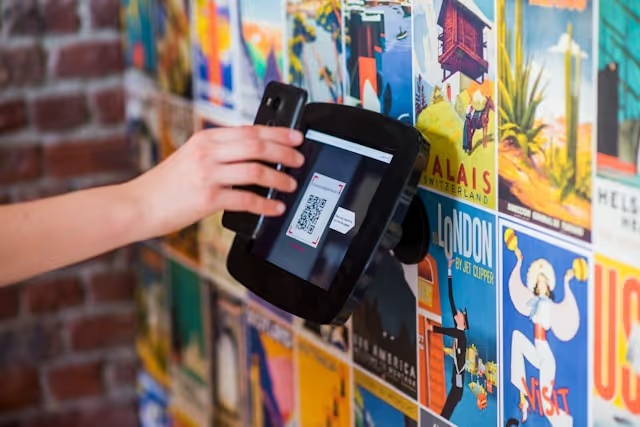
Referral programs provide a natural way to unify offline and online interactions, especially when customers move fluidly between channels. This omnichannel benefit depends far more on the technology layer – QR codes, unified profiles, POS integration – than on the type of reward offered. Any structure can function here. The strength of this benefit comes from the brand’s ability to connect journeys, not from the incentive model itself.
Every successful referral program follows the same high-level structure, but no two programs look identical in practice.
The core steps are universal; the real performance lift comes from tailoring the mechanics to the psychology of your customers and the realities of your business.
Referral programs are most effective when they operate like an extension of your loyalty strategy – rewarding the right behaviors, recognizing advocacy, and creating moments of delight that feel natural within your customer journey.
Brands typically differentiate their programs through a handful of high-impact customization areas:
Each of these decisions shapes how customers feel about sharing your brand, and whether they keep doing it. Small tweaks, applied thoughtfully, compound into a referral engine that aligns with your business model, amplifies your loyalty strategy, and drives sustainable acquisition.
Below is the universal "skeleton" every retail brand can follow.
Clarify what you want the program to achieve – more new customers, higher repeat purchase rates, stronger retention, or increased in-store traffic. Pick the KPIs that matter most (e.g., referral conversion rate, participation rate, CAC from referrals, or LTV of referred customers).
Choose rewards that motivate customers and fit your margins. Common options include store credit, product or percentage discounts, cash payouts, or tiered incentives for top advocates. Double-sided rewards usually deliver the strongest engagement, while access-based incentives can work well for brands built on exclusivity.
Use referral software that integrates smoothly with your ecommerce or POS system and automates tracking and reward fulfillment. Look for strong integrations, accurate multichannel attribution, automated payouts, A/B testing capabilities, and clear analytics.
Make sharing simple and intuitive. The referral path should take one click to start, clearly explain the reward, and use language that sounds like your brand. Surface referral prompts at natural high-intent moments – right after purchase, during loyalty milestones, after positive reviews, or during in-store interactions.
Promote the program across the channels your customers already use: post-purchase emails, loyalty dashboards, social media, app notifications, packaging inserts, QR codes, and POS prompts.
Track performance continuously and refine the program over time. Test different reward formats, referral messaging, landing page layouts, timing triggers, and channel emphasis.
Many of the most common issues stem from overlooking the fundamentals outlined in the earlier framework or from treating referrals like generic loyalty mechanics rather than a distinct, trust-driven growth channel.
Avoiding these pitfalls ensures your program feels natural to customers, integrates cleanly with your loyalty ecosystem, and delivers consistent, scalable results
Referral incentives work only when customers immediately understand them. Multi-step rewards, conditional tiers, “bonus on next purchase” rules, or unclear eligibility slow people down and suppress sharing. This is especially harmful in single-sided programs, where motivation is already weaker. Simple, intuitive offers – particularly double-sided ones – make sharing feel effortless.
A reward that feels irrelevant will not inspire referrals, even if it is financially generous. Discounts may suit value-driven shoppers, while premium customers may respond better to access or exclusive perks. This is why choosing between double-sided, single-sided, and access-based incentives matters. The incentive must align with your brand positioning and the customer’s primary reason for buying.
When customers don’t receive credit for successful referrals because the system fails, trust disappears instantly. Breakdowns happen when ecommerce platforms, POS systems, and loyalty program software are not properly connected. A strong referral engine relies on unified identities across channels, reliable cookies, and automatic reward delivery. Without this, even a beautifully designed program will fail.
Referral programs are uniquely vulnerable to gaming. Customers may create duplicate accounts, refer to themselves with alternate emails, or exploit double-sided rewards for personal benefit. If fraud prevention isn’t built into your software stack and customer service processes, reward costs inflate and the program’s economics collapse. This risk grows when referrals connect to loyalty programs, where points or tier progress create even more incentive to cheat.
Timing is often more important than the reward itself. Asking before a customer has used the product – or long after purchase – leads to low conversion. The strongest referral moments are predictable: right after a great purchase experience, after unboxing, when a customer leaves a positive review, or when they advance within the loyalty program. Missing these emotional peaks dramatically reduces program performance.
Not every customer has equal influence or motivation to refer. Failing to segment advocates means brands underutilize their most loyal customers and overwhelm those who are not ready to refer. High-value customers, loyalty program members, or frequent purchasers often respond well to tiered rewards or personalized prompts, while others may need simpler, lower-effort incentives.
Most referral sharing happens through messaging apps, social platforms, or mobile checkout flows. If links break inside apps, landing pages aren’t mobile-friendly, or copying referral codes is difficult, participation drops immediately. The referral experience must be designed for phones first, especially when in-store QR codes and mobile loyalty apps are part of the journey.
Programs that live on a website footer or inside a hidden account tab rarely succeed. Referrals work best when they appear inside natural, emotionally meaningful moments, post-purchase screens, loyalty dashboards, in-store QR codes, order packaging, or customer service interactions. If the referral mechanism feels bolted on rather than embedded in the journey, customers simply forget it exists.
Even strong programs fail when customers aren’t reminded about them. Referrals require ongoing visibility across email, SMS, social media, apps, loyalty program touchpoints, in-store signage, and POS prompts. Without this, customers may love your brand but never think to share it.
Referral programs grow quickly when they work, and many brands underestimate the need for scalable software. Missing automation, rigid rules, or poor analytics make optimization impossible. Budget tools may look appealing upfront, but enterprise-ready features, especially unified tracking with loyalty program software, become essential as referral volume increases.
Referral programs aren’t a shortcut – they’re a disciplined way to turn customer trust into sustainable growth. When the product delivers and the incentives feel natural, referrals can create the same momentum that powered early successes like Dropbox and other breakout brands.
What separates the best programs today is not flashy rewards but the way they align psychology, technology, and timing. They know when customers are most willing to share, how to make sharing feel effortless, and how to track it reliably across every touchpoint.
Retailers who execute well don’t just win new customers; they cultivate advocates. In a world where paid acquisition keeps getting more expensive, referral programs offer a rare, self-reinforcing growth loop — one still underused by most of the industry. The brands that invest in this now will define the next wave of customer-led growth.
A loyalty program rewards customers for their own purchases and engagement. A referral program rewards them for bringing in new customers. The most effective approach integrates both, treating referrals as an extension of your loyalty strategy rather than a separate initiative. This means using the same technology infrastructure, recognizing top referrers within your loyalty tiers, and rewarding advocacy alongside purchasing behavior.
Double-sided rewards, where both the referrer and their friend get an incentive, typically perform better because they feel fair and encourage sharing. Single-sided programs work only when motivation to share is already strong, which is rare. Choose your structure based on your brand positioning and margins: value-driven retailers do well with straightforward discounts or store credit, while premium brands might explore access-based rewards where exclusivity itself becomes the incentive.
Build fraud prevention into your system from the start. Use referral software with automated fraud detection, implement email and device verification, set limits on referrals per customer, and monitor for suspicious patterns. Establish clear policies your customer service team can enforce. The risk is especially high when referrals connect to loyalty programs where points or tier advancement create additional gaming incentives.
Underpromoting the program. Even well-designed referral programs fail when customers forget they exist. You need ongoing visibility across every channel: post-purchase emails, loyalty dashboards, SMS, app notifications, social media, packaging inserts, in-store QR codes, and POS prompts. Surface referral opportunities at high-intent moments, after purchase, during loyalty milestones, or after positive reviews, not buried in a website footer.
Use technology that maintains unified customer identities across your ecommerce platform, POS system, and loyalty software. Look for solutions that enable QR code sharing in-store, track offline purchases from referred friends, sync with mobile apps, and maintain persistent customer profiles regardless of transaction channel. Without proper integration, attribution fails and customers don't receive credit for their referrals, destroying trust immediately.
Ask at emotionally charged moments: immediately after purchase, post-delivery when product satisfaction is confirmed, after positive reviews, when customers hit loyalty milestones, during subscription renewals, or after great service interactions. Asking too early, before they've experienced the product; or too late, after enthusiasm fades and kills conversion. Build prompts into these natural high-intent moments, not random campaign pushes.

API-first loyalty and gamification engine

Get a weekly dose of actionable tips on how to build and grow gamified successful loyalty programs!