Beauty, Entertainment, Food... TOP 40 rewards programs for customers in 2026
Read now

eCommerce customer loyalty has become the defining financial challenge for online retailers. Acquiring a new customer now costs between $68 and $84 on average – and that number climbed 40 to 60 percent between 2023 and 2025 alone. Meanwhile, the average online store retains only 28 to 30 percent of its customers from one year to the next. The gap between what it costs to attract a shopper and the likelihood that they come back is widening, not shrinking.
This guide covers what eCommerce customer loyalty actually requires in 2026 – the economics that justify prioritizing it, the program mechanics that move repeat purchase rates, and the infrastructure decisions that determine whether a loyalty program scales or stalls.
The economics of retention have always favored repeat business, but several forces have sharpened the math in the past two years.
Acquisition costs have outpaced revenue growth. Google CPCs rose 12.88 percent year-over-year in 2025, and Meta CPMs climbed 20 percent. iOS privacy changes gutted ad targeting, with only 25 percent of iOS users opting in to tracking after Apple’s App Tracking Transparency rollout. Every brand is now competing for the same shrinking pool of efficiently targetable prospects.
Repeat customers carry the revenue. Across eCommerce, 65 percent of revenue comes from existing customers. Loyal buyers spend 67 percent more per order than first-time purchasers. And the probability of a repeat purchase compounds with each transaction: after a first purchase, there is roughly a 27 percent chance the customer returns. After a second purchase, the probability of a third jumps to 45 percent. By the ninth order, the repeat rate exceeds 80 percent.
A small retention improvement delivers outsized profit. The widely cited Bain & Company finding that a five percent improvement in retention can lift profits by 25 to 95 percent still holds up. The lever is margin: retained customers cost less to serve, buy more per transaction, and refer others without a paid media budget attached.
For eCommerce leaders, the takeaway is practical: every dollar shifted from acquisition to retention compounds over time. But retention is not a single tactic. It is a system – and loyalty programs are the infrastructure that gives that system structure.
Not every loyalty program performs equally.
The average eCommerce repeat purchase rate sits at 28.2 percent, but well-designed programs push that figure significantly higher.
Loyalty redeemers show 5.3 times higher repeat purchase rates than non-members, and generate 115 percent higher revenue per customer.
What separates programs that deliver those results from ones that collect digital dust? Four structural elements.
A loyalty points system is still the foundation of most eCommerce programs, and for good reason: points create a tangible ledger of value that customers can see growing. The mechanic works because it activates the endowed progress effect. Customers who can see accumulated value are measurably more motivated to transact again.
Where points-only programs fail is in isolation. A customer earning one point per dollar has no compelling reason to speed up their next purchase or increase their basket size. Effective programs pair points with multipliers tied to specific behaviors: double points on a second purchase within 30 days, triple points on categories with excess inventory, bonus points for reaching a spending threshold. The point mechanic is the foundation; the earning rules are what make it strategic.
Tier-based programs outperform flat structures by a wide margin. Brands using VIP tiers see 80 percent higher ROI compared to single-level programs. The reason is loss aversion. A customer who has earned Gold status and its associated perks (free shipping, early access, exclusive discounts) feels the cost of losing that status if they defect to a competitor. That psychological switching cost is more powerful than any discount code.
The design details matter. Tiers work best when the gap between levels is achievable but requires sustained behavior, when each tier offers at least one benefit the previous tier lacks, and when status is visible to the customer at every touchpoint.
Sephora’s Beauty Insider program (45 million+ members), Nike Membership (160 million+ active members), and adidas adiClub all follow this pattern – and each of these programs generates repeat engagement rates well above their industry averages.
Percentage-off coupons are the default eCommerce reward, and they are also the most corrosive. Every discount trains customers to wait for the next sale, eroding margins over time. The industry data reflects this: investment in promotions and discount-based offers has fallen from 33.3 percent in 2021 to 11.1 percent in 2026, a structural decline that shows no sign of reversing. The strongest programs diversify their reward mix.
Experiential rewards (early access to product drops, invitation-only events, personalized styling consultations) create value without reducing price. Recognition rewards like badges and achievement milestones tap into status motivation. Variable rewards (mystery boxes, randomized prizes) use the same dopamine mechanics that make mobile apps addictive.
The data supports the mix. Top-performing loyalty programs incorporate personalization (82 percent), gamification (67 percent), and experiential rewards (74 percent) – not discounts alone.
Traditional programs only reward transactions, which means they go silent between purchases. For categories with long purchase cycles (fashion, furniture, electronics), that silence can last months. And silence is where churn happens.
The most effective eCommerce loyalty programs reward non-purchase actions: product reviews, social sharing, app visits, content interaction, quiz completions, and referrals. These touchpoints keep the brand present in the customer’s routine during the gap between orders.
adidas adiClub awards points for workouts logged on the adidas Running app, product reviews, and event attendance alongside purchases.

Nike Membership avoids points entirely and instead rewards engagement with early access, personalized training plans, and event invitations.

Both approaches treat non-transactional behavior as equally valuable to buying – and both programs count their active members in the hundreds of millions.
If points and tiers are the structural foundation, gamification is the engagement layer that keeps the structure active.
A recent industry report found that 42.1 percent of loyalty professionals now rank gamification as the mechanic with the biggest medium-term impact on their programs.
Gamification works in eCommerce because it introduces the same behavioral loops that keep people engaged with fitness apps, language-learning tools, and mobile games. Three mechanics have proven especially effective for online retail.
Challenges with deadlines are the most direct revenue driver. For example, “Buy twice this month and unlock free shipping on your next order.”
Learn how how limango increased average order value by 41% with gamified loyalty
The combination of a goal, a time constraint, and a variable reward activates goal-gradient behavior – customers accelerate activity as they approach the finish line. A customer who might have purchased once now purchases twice, and the cost to the brand only materializes after the incremental behavior occurs.
Streaks and frequency mechanics work the other side of the equation – preventing lapse: "Visit the site three times in seven days to earn a bonus multiplier; Return within 14 days of your last purchase for double points."
Streak mechanics exploit loss aversion: customers who have built a streak are reluctant to break it.
For categories where purchase frequency is the key revenue driver (beauty, grocery, pet supplies), streaks consistently pull forward purchases that might otherwise happen later or not at all.
Progress bars and milestones are the lowest-effort, highest-impact nudge in the loyalty toolkit. Showing a customer that they are 70 percent of the way to their next reward or tier upgrade works because the endowed progress effect makes that final 30 percent feel more achievable than the first 70 percent felt at the start. This mechanic costs almost nothing to implement and increases both session engagement and conversion at checkout. Limango, an online retail platform running its loyalty program on Open Loyalty, saw a 41 percent increase in average order value after introducing gamified challenges and tiered rewards – gains that came without deepening discounts.
Brands that treat gamification as a series of one-off campaigns (a holiday spin the wheel, a seasonal leaderboard) see short-term engagement spikes that fade. Brands that embed gamification into their loyalty infrastructure see compounding returns because customers build persistent progress, status, and habits over time.
The difference is architectural. Infrastructure-level gamification means challenges, streaks, leaderboards, and games of chance run on the same rule engine as points and tiers. A single campaign can combine a point bonus with a challenge mechanic and a tier-progression trigger without requiring multiple systems or middleware. For multi-market eCommerce brands, this also means different regions can run different gamification campaigns with different rules – without duplicating the underlying platform.
Any eCommerce customer loyalty program that treats all members identically will underperform one that adapts to individual behavior.
Personalized experiences are no longer a nice-to-have. They are the primary driver of loyalty engagement, with 82 percent of top-performing programs incorporating them.
Effective personalization in eCommerce loyalty operates at three levels.
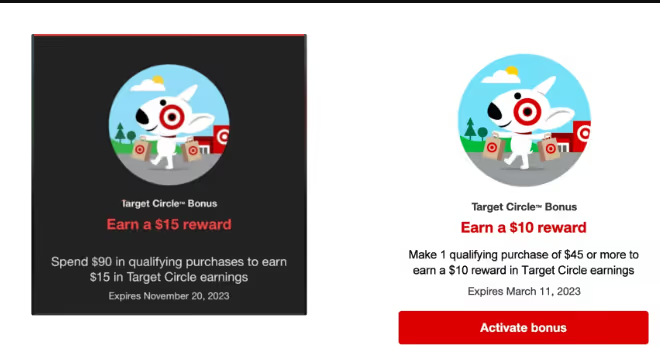
The first is reward personalization. Offering a skincare customer early access to a new serum launch is more compelling than a generic 10-percent-off code. Programs that match rewards to individual purchase history and browsing behavior see higher redemption rates, which in turn drives the engagement loop that makes the program self-sustaining.
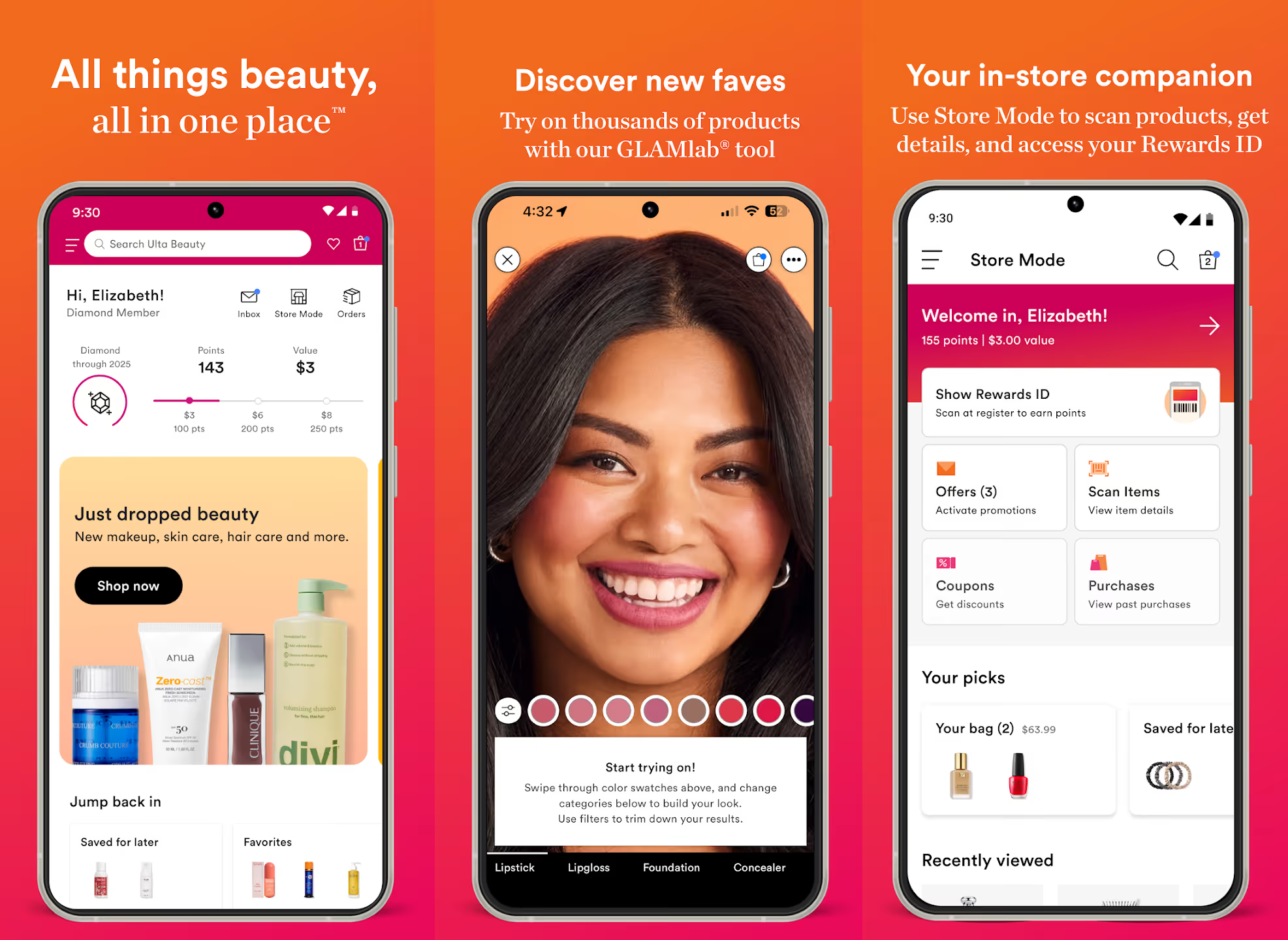
The second is communication personalization. When a customer is 50 points away from their next reward, telling them that in a triggered email converts at a higher rate than a generic “check out our new arrivals” blast. The specificity creates urgency that a batch newsletter cannot replicate.
The third is challenge personalization. A customer who buys running shoes should see a “Complete three activewear purchases” challenge, not a “Buy three home décor items” challenge. When challenges align with existing behavior patterns, completion rates climb – and so does the incremental revenue they generate.
The infrastructure requirement for eCommerce customer loyalty is clear: the system must be able to ingest customer event data in real time and use it to personalize what each member sees, earns, and is challenged to do. Batch-processed systems that update overnight cannot deliver the in-session personalization that moves conversion.
Loyalty programs generate a lot of data. The discipline is in knowing which metrics actually predict long-term value. These five loyalty program KPIs matter most for eCommerce.
Repeat purchase rate is the most direct measure of whether the loyalty program is working – the percentage of customers who make a second (or third, or fourth) purchase within a defined window. If your program has been live for six months and this number has not moved, something structural needs to change.
Customer lifetime value (CLV) measures the total revenue a customer generates over their relationship with the brand. A loyalty program should push CLV upward over time – and 59 percent of loyalty professionals now cite CLV improvement as their primary strategic goal.
Active member rate tracks the percentage of enrolled members who engage with the program in a given period. A program with two million members and a 12 percent active rate is underperforming one with 500,000 members and a 45 percent active rate. This metric separates real engagement from inflated enrollment numbers.
Redemption rate reveals whether your rewards are compelling enough to drive behavior. Points that never get redeemed are not evidence of program success – they signal that the value exchange is broken. McKinsey’s loyalty research shows that members who actively redeem rewards spend 25 percent more per transaction than inactive members, which means a healthy redemption rate does not just keep the engagement loop alive – it directly lifts revenue per customer.
Incremental revenue per member is the hardest to measure and the most valuable. It requires a control group methodology – holding back a segment of eligible customers and comparing their purchasing behavior against active program members over time. Without this comparison, every revenue improvement might be coincidence rather than program effect.
Even well-designed programs underperform when teams make avoidable structural errors. Three patterns show up repeatedly across eCommerce brands.
The first is launching without a control group. If you roll out a loyalty program to all customers at once, you have no way to isolate its impact. Every improvement in repeat purchase rate could be seasonal, coincidental, or driven by a concurrent campaign. Hold back 10 to 15 percent of eligible customers as a control segment and compare outcomes over 90 days. Without this baseline, every metric is ambiguous.
The second is rewarding only transactions. Programs that limit earning to purchases go silent during the gap between orders – and that gap is where most churn happens. Rewarding app engagement, referrals, reviews, and social interactions keeps the program alive between transactions. The brands with the highest active member rates are the ones that give customers reasons to interact with the program even when they are not buying.
The third is treating the program as a one-time launch rather than an ongoing channel. Programs that ship with a fixed set of challenges and never update them see engagement peak within 60 days and decline afterward. Members who complete all available challenges have nothing left to work toward. The most effective programs rotate challenges monthly, introduce limited-time events, and adjust mechanics based on participation data. This requires a platform that supports rapid configuration changes without development cycles – a distinction that matters when evaluating technology.
Every eCommerce vertical has different purchase frequency patterns, different margin structures, and different competitive dynamics. A loyalty program for a fast-fashion brand with a six-week purchase cycle needs a different design than one for a furniture brand where the average customer buys twice a year.
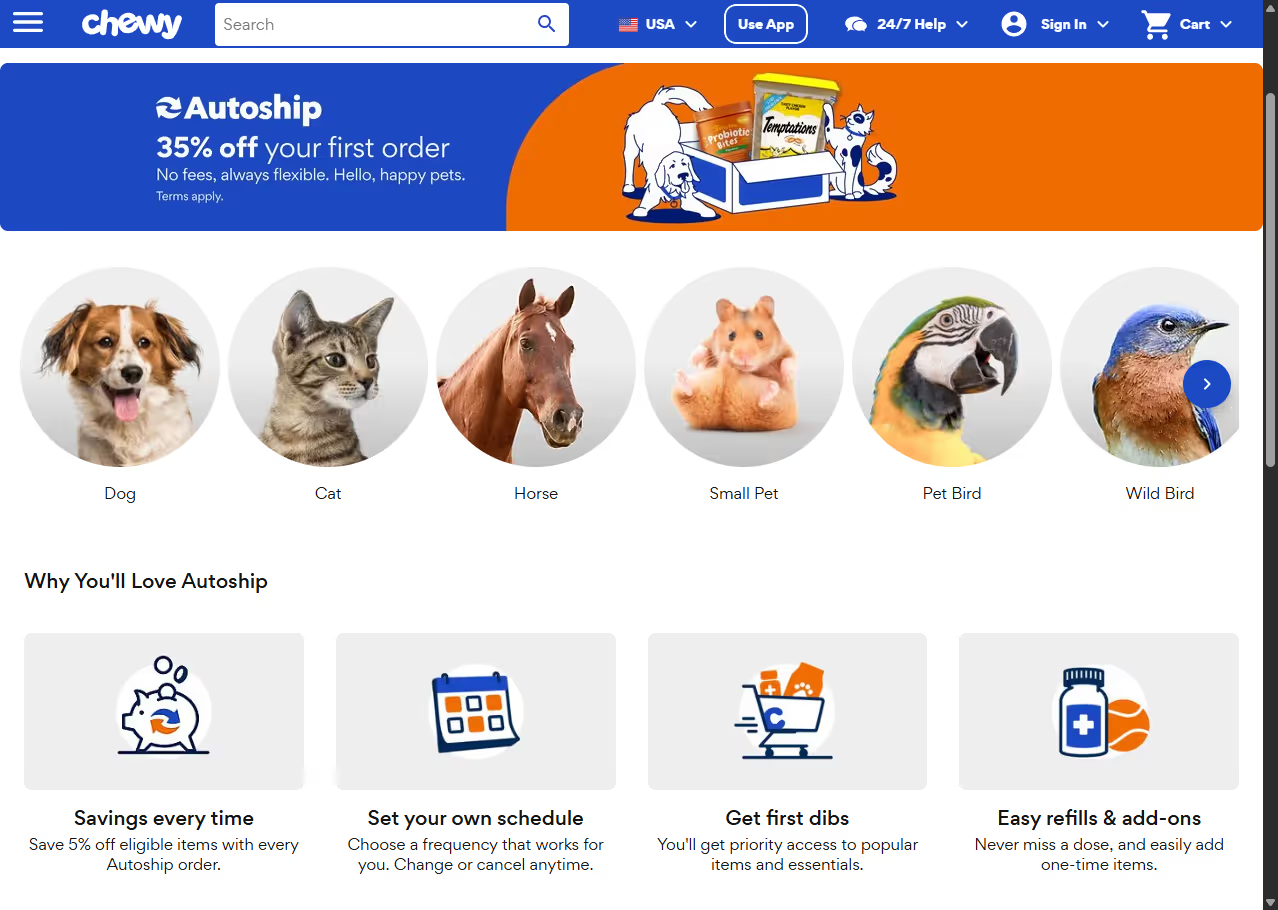
In high-frequency categories like beauty, grocery, and pet supplies, the priority is streaks, frequency-based bonuses, and subscription incentives.
The goal is to shorten the gap between purchases. Auto-replenishment triggers paired with loyalty bonus points work especially well here because the product consumption cycle naturally invites repeat orders.
In medium-frequency categories like fashion, athleisure, and electronics, tier progression and non-purchase engagement matter more than transaction volume alone.
Customers in these categories need reasons to interact with the brand between purchases. The best retail loyalty programs in this space combine transactional rewards with community, content, and status mechanics to keep members active during longer purchase cycles.
For IKEA, it means a program that works as a lifestyle companion, supporting the everyday IKEA experience both in-store and at home.
In low-frequency categories like furniture, luxury, and home improvement, referral programs and post-purchase engagement carry the most weight.
The purchase cycle is too long for frequency-based mechanics to be effective.
Instead, turn satisfied customers into advocates through referral incentives that bring in new buyers at a fraction of paid acquisition cost. Review requests, care tips, and complementary product recommendations give the brand reasons to stay in contact without feeling intrusive.
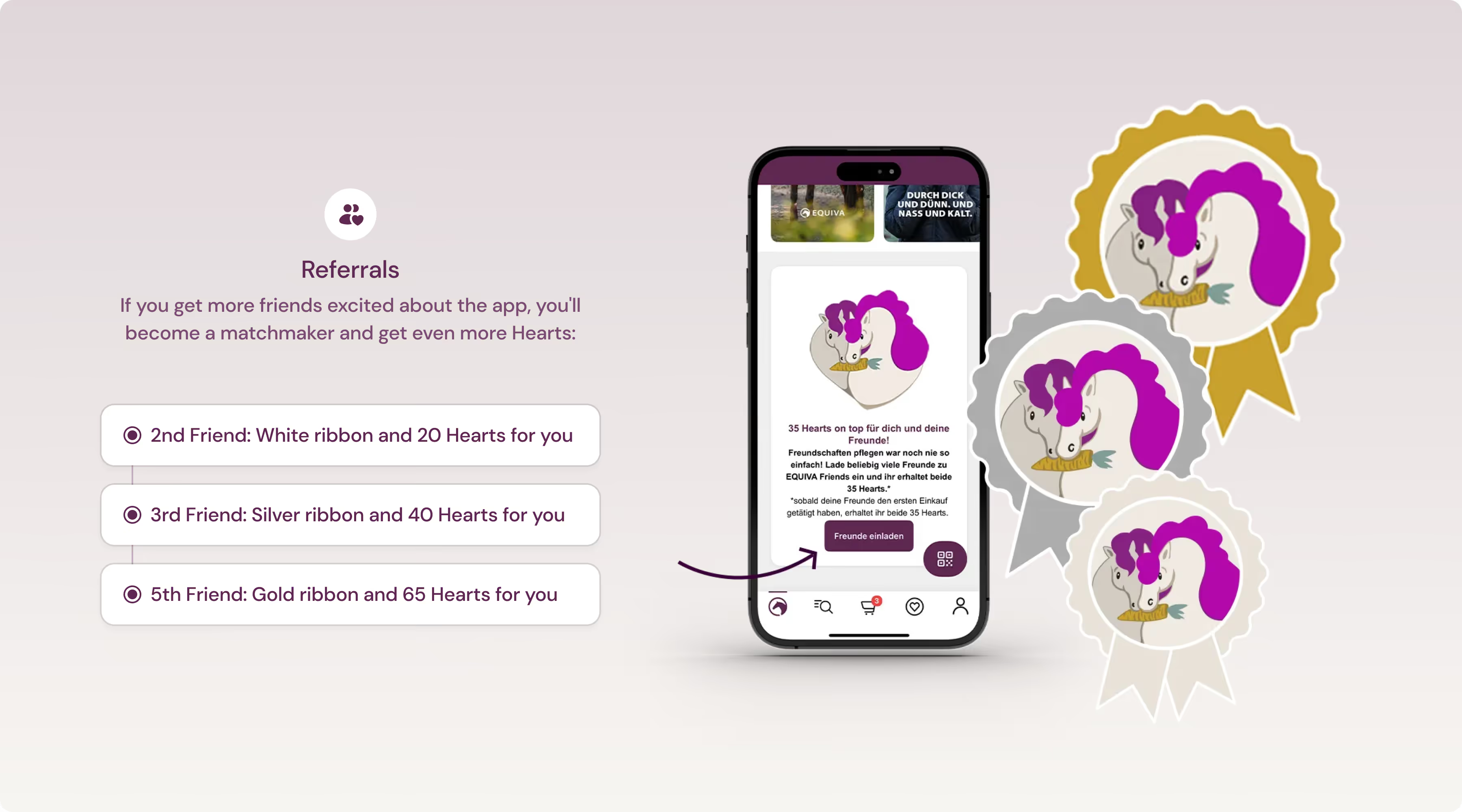
EQUIVA, an equestrian retailer, used this approach with Open Loyalty to double buyer frequency and save €240,000 in annual customer acquisition costs through behavior-driven referral mechanics matched to the right moment in the customer journey.
A loyalty program is only as capable as the technology running it. Brands that start with a basic plugin often hit a ceiling within 12 to 18 months when they need to add gamification, multi-market rules, or real-time event processing. The migration cost at that point is typically higher than the investment in a purpose-built eCommerce loyalty platform would have been from the start.
The evaluation should focus on four capabilities.
First, real-time event processing. Can the platform ingest non-purchase events (app opens, page views, social shares, referral completions) and trigger rewards instantly? Batch processing that runs overnight cannot support gamification mechanics that depend on real-time feedback.
Second, composable architecture. Does the platform operate as a headless API service that can power loyalty across web, mobile app, in-store POS, and partner integrations without duplicating configuration? For brands selling through multiple channels, this flexibility is not optional.
Third, native gamification. Are challenges, streaks, leaderboards, and games of chance built into the core rule engine, or do they require third-party integrations? Bolt-on gamification creates data silos and slows campaign execution. A natively integrated engine means the marketing team can launch a challenge that references a customer’s tier status, point balance, and recent purchase history – all in one campaign.
Fourth, multi-market support. For brands operating internationally, can the platform run different rules, currencies, and reward catalogs per market without requiring separate instances? This is a pain point that typically only surfaces after launch, when fixing it requires re-platforming.
For teams evaluating their options, Open Loyalty’s buyer’s guide covers the full framework – including questions to ask vendors, pricing models, and implementation timelines across the leading platforms.
eCommerce customer loyalty is not a program you launch and forget. The brands that retain customers at above-average rates share a common pattern: they treat loyalty as a system with multiple reinforcing mechanics – points, tiers, gamification, personalization, and non-purchase engagement – rather than relying on any single tactic.
The data supports this compounding approach. Programs with multiple engagement mechanics see 40 percent higher participation, and members who redeem rewards generate over five times the repeat purchase rate of non-members. Every dollar spent on retention generates returns that accumulate over time, while acquisition budgets reset to zero each quarter. The brands investing in loyalty infrastructure now are building a customer base that becomes harder for competitors to erode with every passing month.
The starting point for any eCommerce customer loyalty strategy is an honest assessment of where your current program stands – and whether the technology behind it can support where you need it to go. For eCommerce brands ready to build customer loyalty that goes beyond points and discounts, the infrastructure choices you make today will determine your retention economics for the next three to five years.
The average eCommerce repeat purchase rate is 28.2 percent. Well-designed loyalty programs push that figure significantly higher – loyalty redeemers show 5.3 times higher repeat purchase rates than non-members. Rates vary by vertical: subscription-heavy categories like beauty and pet supplies tend to land above 35 percent, while furniture and luxury sit closer to 15 to 20 percent.
Loyalty programs increase CLV through three mechanisms: they shorten the gap between purchases (via challenges and streak mechanics), they increase average order value (via tier-based perks and point multipliers), and they reduce churn by creating psychological switching costs through accumulated status and rewards.
59 percent of loyalty professionals now cite CLV improvement as their primary strategic goal.
A standard points program rewards transactions with a fixed earn rate. Gamification adds behavioral mechanics on top of that foundation – challenges with deadlines, streak bonuses, progress bars, leaderboards, and variable rewards.
These mechanics tap into goal-gradient behavior and loss aversion, which is why programs using gamification report 40 percent higher repeat participation than points-only models.
Acquiring a new eCommerce customer costs $68 to $84 on average, and that figure rose 40 to 60 percent between 2023 and 2025. Retention is significantly cheaper – existing customers already know the brand, cost less to serve, and spend 67 percent more per order than first-time buyers.
A five percent improvement in retention can lift profits by 25 to 95 percent.

API-first loyalty and gamification engine

Get a weekly dose of actionable tips on how to build and grow gamified successful loyalty programs!