A loyalty management system is a software solution that helps businesses design, track, and manage programs to reward customers for repeat purchases and engagement, often utilizing points, discounts, or exclusive perks. Effective customer loyalty management plays a crucial role in building long-term customer relationships and rewarding engagement, evolving from traditional physical methods to advanced digital solutions. Points engine, tiers, gamification, API-first architecture and more – with Open Loyalty benchmarks.
This guide identifies the 10 features that separate an enterprise-grade loyalty management system from a basic points tracker – and explains exactly how each one affects customer lifetime value. If you’re evaluating platforms, rebuilding a legacy program, or mid-migration and questioning your current architecture, this is written for you. Choosing the right loyalty program software and the right customer loyalty platform is crucial–look for solutions with API integration, scalability, and flexibility to support complex, personalized loyalty programs that can adapt to your evolving business needs.
We use Open Loyalty as the reference platform throughout: it’s the system our team has deployed across retail, financial services, and airline programs, and its API-first architecture makes the technical tradeoffs concrete rather than theoretical. When selecting loyalty management software, businesses should define their loyalty program goals–such as customer retention or advocacy–and evaluate how each platform fits into their existing tech stack.
Most loyalty platforms handle the basics: points accrue on purchase, members redeem for discounts, a tier badge appears in the app. This reflects the traditional loyalty approach–transaction-based, focused on points and rewards. However, modern loyalty management software goes far beyond these conventional methods, supporting advanced, data-driven strategies that integrate social engagement, advocacy, and value-sharing ecosystems. The gap opens the moment you need to do anything more complex – and for most mid-market and enterprise operators, ‘more complex’ arrives within 12 months of launch.
The three platform categories behave very differently under pressure, especially when you compare traditional bundled tools with headless loyalty software architectures:
Modern management software acts as a centralized platform for building long-term customer relationships and delivering personalized rewards, integrating and automating various aspects of customer engagement, data analysis, and campaign management. The evolution from traditional loyalty to comprehensive loyalty management software is clear: today’s systems are data-driven, omni-channel, and adopted by 63% of high-performing marketers.
The decision point is usually this: a basic SaaS platform fits a single-channel, single-currency, low-SKU program. Once you add a second market, a second earn currency, or any non-transactional trigger (app login, product review, referral), the configuration ceiling arrives fast. Legacy enterprise platforms can stretch further but extract the cost in implementation time and vendor dependency. An API-first loyalty management system – built around a headless commerce model – treats every loyalty interaction as a composable event, which means your engineering team integrates what they need without waiting for a platform vendor to expose it, using an API-first loyalty and gamification platform as the backbone.
The 10 features below each represent a capability where that architectural difference produces a measurable business outcome.
A well-configured points engine directly reduces points liability on your balance sheet – earned points that members never redeem are accounting exposure, not engagement. Points-based programs allow customers to earn points for each transaction and other actions, such as signing up for alerts or leaving reviews. These programs are specifically designed to encourage repeat purchases by letting customers earn points that can be redeemed for rewards or discounts, fostering ongoing engagement and customer retention. The goal is precision: award the right points for the right behaviors, expire idle balances before they accumulate, and keep redemption velocity high enough to drive return visits without eroding margin.

Basic platforms accrue points on transaction value, full stop, whereas a dedicated loyalty points system supports far more granular earning and redemption logic. Enterprise-grade engines like Open Loyalty’s points engine support granular accrual rules across multiple event types: purchase amount, SKU category, channel (in-store vs. app vs. web), basket composition, and custom events fired via webhook payload. A grocery retailer, for example, can award 2× points on private-label products between Tuesday and Thursday, while an airline can accrue miles on ancillary purchases – seat upgrades, lounge access – using the same rule engine without a line of custom code.
Expiry logic is where many platforms fall short. Open Loyalty supports both absolute expiry (points expire on a fixed calendar date) and rolling expiry (points expire X days after the last qualifying activity), configurable per tier or per campaign. Rolling expiry is particularly effective in financial services loyalty programs, where cardholders may transact infrequently – our implementations have shown a 15–25% reduction in dormant point balances when rolling expiry replaces fixed annual cycles.
Redemption rate benchmarks from the reports indicate that programs with transparent, predictable earn-and-burn rules sustain. Open Loyalty exposes all accrual rule configuration through its API-first architecture, which means rule changes deploy without a release cycle – critical when you’re reacting to a competitor promotion mid-quarter.

The redemption rate in loyalty programs. Source: https://passkit.com/blog/loyalty-program-data/
Tiered loyalty programs reward customers based on their spending levels, with higher tiers offering better rewards as customers spend more over time. This structure shifts the customer’s decision from ‘should I buy?’ to ‘how much more do I need to spend to reach the next level?’ That psychological shift is measurable: our implementations across retail and financial services have shown AOV lifts of 15–30% among members within 20% of a tier threshold, compared to members comfortably mid-tier.
The mechanics that produce this outcome are more complex than most evaluators expect. Tier threshold logic must handle at least three variables: the qualifying currency (spend, points, transactions, or a composite), the evaluation window (rolling 12 months vs. fixed calendar year), and the recalculation frequency. A system that only recalculates tier status at month-end misses the real-time feedback loop that drives incremental spend decisions.
Demotion logic is where many platforms get this wrong. Abrupt downgrades trigger churn. Open Loyalty supports configurable grace periods and soft demotion warnings, allowing you to notify a Gold member 60 days before status drops and trigger an automated win-back campaign via webhook payload. The tier event fires the campaign; the campaign prevents the demotion.
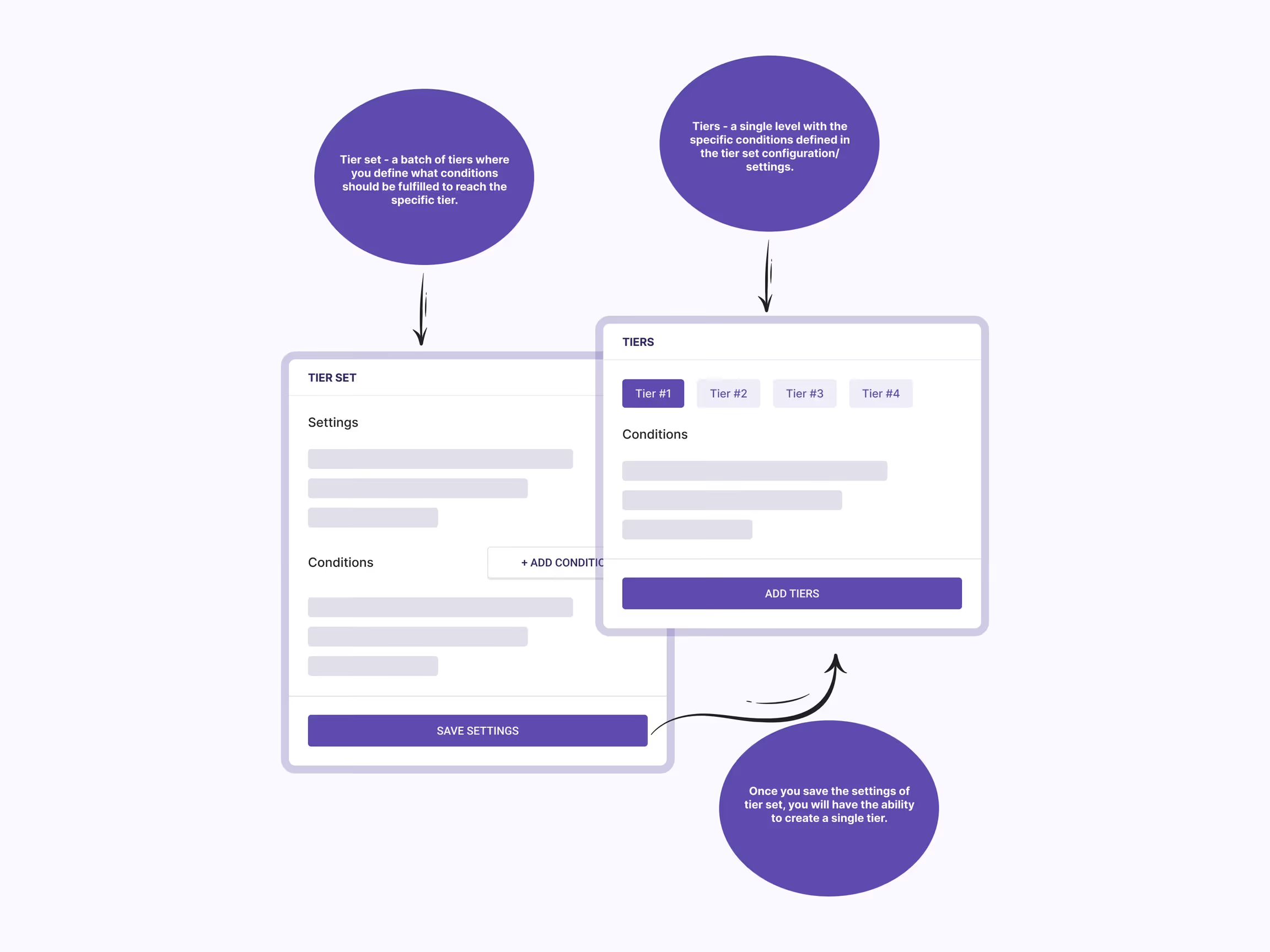
For customer lifetime value modeling, tier structures also give your CRM a clean segmentation signal. Members who consistently qualify for top-tier status are your highest-CLV cohort – Open Loyalty’s API-first architecture makes that tier status queryable in real time by your CDP or marketing automation layer, without batch syncs or data lag.
In multi-industry deployments – retail, airlines, and financial services – the tier configurations that perform best share one trait: they make progress visible at every touchpoint, not just in a dedicated loyalty portal.
Gamification features earn their place in a loyalty management system only when each mechanic maps to a measurable loyalty KPI – not when they generate clicks or app opens that never convert to revenue. The three mechanics worth building are challenges, badges, and streaks, and each targets a different part of the loyalty funnel. Loyalty rewards can include points, badges, and other incentives for various actions, not just purchases.
Challenges drive purchase frequency. A challenge – “buy three times in 30 days, earn 500 bonus points” – creates a defined behavioral contract with the customer. The points engine executes this through event-driven triggers: each qualifying transaction fires a webhook payload that increments a counter against the challenge rule. When the threshold is met, the accrual posts automatically. Open Loyalty’s challenge framework supports multi-condition logic, so you can scope challenges by product category, channel, or SKU – not just transaction count.
Badges drive activation. New members who earn a first-purchase badge within 7 days of enrollment show significantly higher 90-day retention than those who don’t. The mechanic works because a badge signals program membership concretely – it’s the difference between a card in a wallet and an identity the customer has started to build.
Streaks drive retention. A streak – consecutive weekly purchases, consecutive app check-ins – applies loss aversion directly. Breaking a streak feels worse than the bonus feels good, which is exactly the asymmetry that retention mechanics need. Our implementations in retail have shown that streak-based campaigns lift 60-day repeat purchase rates by 18–25% compared to equivalent point multiplier offers with no behavioral commitment structure.
Rewarding customers for engagement beyond purchases–such as social sharing, referrals, reviews, or user-generated content–can increase overall engagement and customer satisfaction. By integrating loyalty rewards for these actions, brands can turn loyal customers into advocates, boost referrals, and build an engaged community that drives brand growth.
Open Loyalty’s gamification layer integrates directly with its points engine, meaning gamification rewards post through the same accrual pipeline as standard transactions, enabling highly targeted loyalty campaign management without additional tooling. There’s no parallel ledger to reconcile, which matters for points liability reporting at scale.
A robust loyalty management system should include referral programs as a key component, as they play a crucial role in acquiring new customers and boosting engagement. Integrating referral programs within broader loyalty initiatives not only increases product adoption but also drives sales growth by leveraging existing customers to bring in new ones.
A referral program engine buried inside a third-party plugin creates attribution gaps, delayed reward issuance, and reconciliation headaches. A native referral engine – one that shares the same accrual rules engine and member ledger as your core points program – eliminates all three.
The business case is straightforward: referred customers typically show higher customer lifetime value than acquisition-channel customers, while CAC runs materially lower because the acquiring member absorbs part of the conversion work.
Open Loyalty’s referral engine handles three mechanics that matter at the implementation level, and these same mechanics underpin effective loyalty campaign software:
Fragmented accrual – where your POS earns points that your mobile app can’t see until a nightly batch job runs – is the fastest way to erode member trust. Omnichannel loyalty management must unify customer touchpoints and multiple channels for a seamless experience, ensuring that customers can interact with your brand consistently whether in-store, online, or via mobile. A 2024 Harvard Business Review study found that 73% of customers prefer to shop across multiple channels, highlighting the need for omnichannel consistency in loyalty programs. Unified omnichannel accrual and redemption means a customer earns at the in-store checkout, opens the app thirty seconds later, and sees the updated balance in real time. That’s a technical requirement, not a UX nicety.
The mechanism that makes this work is webhook payload design. When a transaction occurs at any customer touchpoint, the points engine must fire an event-driven webhook that carries a complete transaction context: member ID, transaction value, channel identifier, applicable accrual rule IDs, and the resulting points delta. Downstream systems – your mobile app, eCommerce platform, and POS – subscribe to those webhooks and update local state immediately, without polling. Integrating customer data from various sources enables a single customer view, which enhances the personalization of loyalty programs.
Open Loyalty’s API-first architecture is built around exactly this model, simplifying the integration of an API-first loyalty engine into existing eCommerce, POS, and mobile stacks. Every earn and burn event emits a structured webhook payload that consuming systems can act on within milliseconds. In retail deployments, our implementations have shown member app engagement increases of 25–40% when balance updates shift from overnight batch to real-time sync, because members can see and act on rewards before they leave the store.
Airline implementations present a more complex variant: accrual rules must account for fare class, loyalty tier, partner codeshares, and redemption against seat inventory – all in a single transaction context. Open Loyalty’s points engine handles multi-rule accrual stacks natively, applying each rule in sequence with configurable priority and conflict resolution, so a business-class booking on a partner flight calculates correctly without custom middleware.
The redemption side matters equally. A unified points engine means members can redeem rewards easily across multiple channels, ideally through a digital wallet that provides real-time access to rewards. This seamless redemption experience across all customer touchpoints is essential for accurate points liability forecasting and member satisfaction.
A SaaS monolith loyalty platform ships fast on day one – and then charges you every time you need a custom integration, blocks your stack choices, and requires a full re-platforming cycle whenever the vendor decides to upgrade. An API-first loyalty management system inverts that model: the loyalty logic lives behind REST endpoints, and your team connects it to whatever frontend, CRM, or POS makes sense for your architecture.
The business case is integration speed and future flexibility. Our implementations have shown that teams migrating from monolithic loyalty platforms to an API-first architecture reduce integration time by 40–60% on subsequent channel additions – because the first integration establishes the pattern and every subsequent touchpoint follows the same webhook payload structure. An airline adding a hotel partner to its points engine, a retailer connecting a new self-checkout vendor, a financial services firm exposing loyalty balance to a third-party app: each is a matter of calling a documented endpoint rather than negotiating a vendor roadmap.
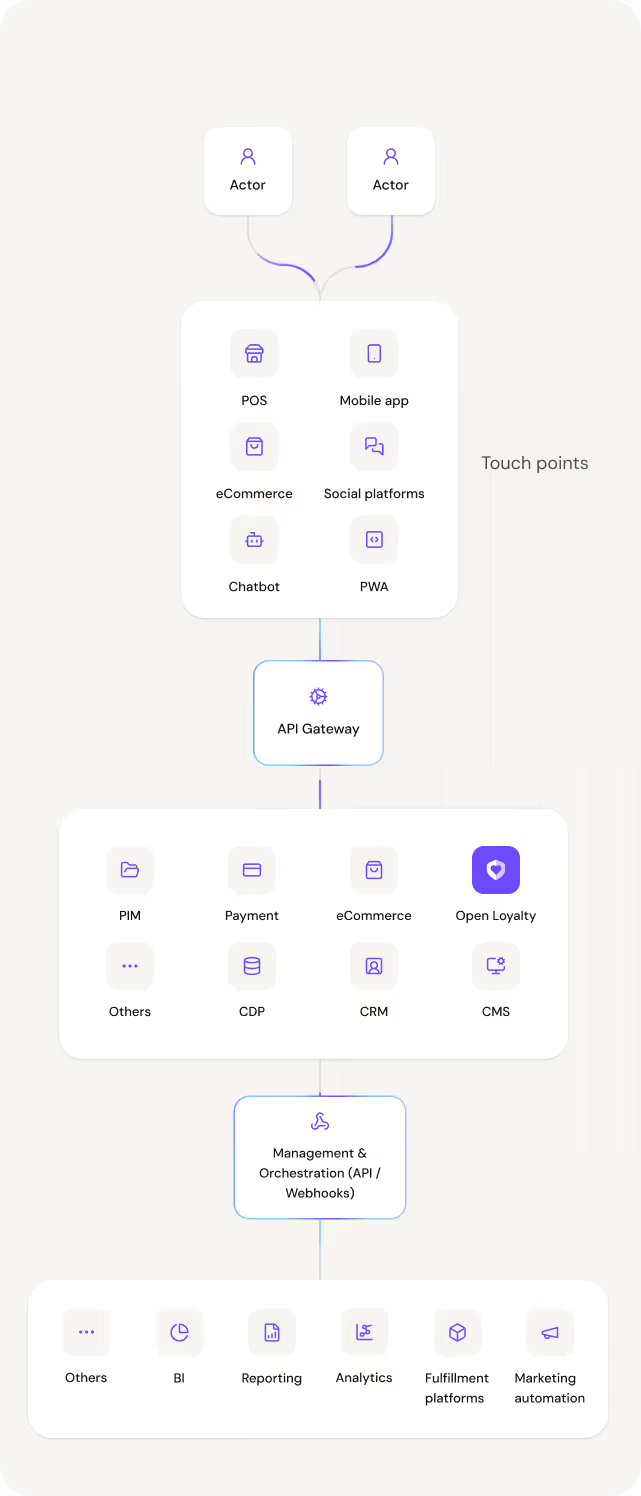
Open Loyalty is built headless from the ground up, offering an enterprise-ready SaaS loyalty platform rather than a monolithic add-on module. Every loyalty action – tier threshold evaluation, accrual rule execution, referral program attribution – is exposed via API. Webhook payloads fire on event-driven triggers, so downstream systems (ESPs, CDPs, real-time analytics platforms) receive loyalty events within milliseconds without polling. There is no front-end layer to work around and no proprietary SDK that creates stack lock-in.
The upgrade risk contrast is equally significant. Monolith upgrades often break custom integrations; in a headless deployment, the API contract is versioned independently of the core points engine, so your team upgrades on its own schedule rather than the vendor's.
For IT stakeholders doing integration risk assessment, the right question is not 'does it have an API?' – every modern platform does. The question is whether the API covers 100% of platform functionality or only the parts the vendor chose to expose.
Redemption rate is one of the most misread metrics in loyalty program management. A high redemption rate feels like success – members are engaged, rewards are moving. A low rate signals the opposite problem: points are accumulating into unredeemed liability that sits on your balance sheet and quietly erodes program economics. The business outcome you’re optimizing for isn’t a single number; it’s the relationship between redemption velocity, points liability exposure, and customer lifetime value change across cohorts.
Real-time analytics and detailed reporting tools are essential for tracking customer engagement and measuring program effectiveness. These tools allow you to monitor key metrics like customer retention rates and ROI, which are critical for evaluating the success of your loyalty program and making data-driven improvements.
Most platforms can export this data to a BI tool. The question is whether your team can act on it without a three-day extraction cycle.
Open Loyalty surfaces a real-time analytics layer that tracks the KPIs a loyalty program manager actually needs to make daily decisions, as demonstrated in enterprise loyalty program implementations:
Dashboards pull from the same event stream that drives accrual rules and webhook payloads, so the figures reflect program state in real time rather than last night’s batch job. Our implementations across retail and financial services have seen teams reduce time-to-insight on campaign performance from days to under two hours – a difference that matters when a redemption spike signals fraud or a tier migration campaign is underdelivering.
Static segmentation breaks loyalty programs. When you only segment customers at signup and update monthly in batch, the accrual rules reflect who they were – not who they are now. Dynamic segmentation enables marketers to target specific customer segments in real time, recalculating membership criteria as customer behavior changes. This allows for more effective and personalized marketing campaigns.
The business outcome: segment-specific accrual rule overrides that activate the moment a customer qualifies, not at the next scheduled sync. For example, a retail customer who completes their third purchase in 30 days should enter a high-frequency buyer segment and immediately begin earning at an elevated multiplier – not three weeks later when the ETL job runs.
Loyalty segmentation aims to enhance customer loyalty and maximize customer lifetime value. In addition to the primary objective, it also has secondary goals, including optimizing resource allocation, discovering valuable insights through data analysis, and fostering involvement and gratification. You can create a comprehensive framework for long-term success by addressing the primary and secondary objectives."
Paweł Dziadkowiec, Loyalty Strategy Consultant, ex-BP
Open Loyalty’s segmentation engine continuously evaluates customers against behavioral criteria, leveraging customer data such as purchase frequency, recency, and monetary value – standard RFM dimensions – plus event-driven triggers like product category affinity, redemption velocity, and tier threshold proximity, so marketers can run personalized loyalty campaigns that respond instantly to behavior changes. By analyzing customer behavior and leveraging customer data, marketers can create specialized campaigns and tailored rewards based on purchase history, preferences, and demographics, enabling advanced personalization. Each segment can carry its own accrual rule overrides, reward catalog restrictions, and points expiry policies, applied at the transaction level without manual intervention.
For teams migrating from a CDP with its own segmentation layer, Open Loyalty’s API-first architecture supports bidirectional sync: your CDP defines the segments, Open Loyalty applies the corresponding earning logic via webhook payload. This avoids duplicating segmentation infrastructure while keeping loyalty mechanics tightly coupled to customer data.
In our financial services deployments, segment-specific accrual overrides have lifted engagement rates among dormant-risk cohorts by within 60 days of activation.
Loyalty programs that operate across borders fail at predictable points: a customer in Germany earns points in USD, a reward catalog built for US consumers shows irrelevant options in Japan, and GDPR-sensitive member data sits on servers with no defined regional boundary. Multi-market readiness isn’t a nice-to-have – it’s a prerequisite for any enterprise omnichannel loyalty rollout.
Open Loyalty’s architecture handles three distinct layers of international complexity. First, currency conversion logic operates at the points engine level: accrual rules can be configured to normalize spend values across currencies before points are issued, so a €50 purchase and a $50 purchase yield equivalent points based on real exchange rates rather than nominal amounts. This prevents arbitrage behavior common in cross-border programs where members shift spend to whichever currency inflates their accrual.
Second, locale-specific reward catalogs let each market surface different redemption options – a cashback reward relevant in one region, a partner voucher in another – without branching the core points ledger. Understanding customer preferences in each market is key to offering relevant rewards and experiences, ensuring that the catalog aligns with local tastes and expectations. Catalog visibility rules attach to member locale attributes, keeping the backend unified while the front-end experience stays market-appropriate.
Third, data residency configuration allows member PII to be stored within defined regional boundaries, which matters acutely for programs operating under GDPR in Europe or PDPA in Southeast Asia. Our implementations across retail and financial services have required per-region data partitioning as a compliance condition before any program could go live – not an afterthought.
Compliance failures in loyalty programs carry two costs: regulatory fines and member trust erosion. A data breach exposing points balances and purchase history, or a failed right-to-erasure request from a German member, can trigger GDPR penalties and accelerate churn faster than any competitor offer. Security and compliance aren't procurement checkboxes – they determine whether your DPO will sign off on launch.
The compliance surface area in a loyalty system is wider than most teams expect. GDPR consent must be captured at enrollment and propagated through every downstream system – including the points engine, the customer data platform, and any third-party reward partners. Right-to-erasure requests are particularly complex: deleting a member record must reconcile against the points ledger, outstanding redemptions, and audit trails without breaking financial reporting.
Open Loyalty's API-first architecture makes consent state a first-class data attribute, passed via webhook payloads to connected systems so consent changes propagate in real time. The platform supports right-to-erasure workflows that anonymize member identity while preserving ledger integrity for accounting purposes – a distinction regulators accept and auditors require.
For enterprise procurement, Open Loyalty supports SOC 2 Type II compliance and regional data hosting configurations, allowing teams to pin member data to specific geographic infrastructure – critical for EU deployments and increasingly relevant for markets like Brazil (LGPD) and India.
Use this checklist to score platforms during your shortlist phase. Each criterion maps to a feature section above. When evaluating, prioritize selecting the right loyalty software and loyalty program software–look for platforms that centralize program management, track customer data, and provide optimization insights. Consider vendors with a proven track record of successful implementations across industries. Ensure the platform supports effective loyalty programs that leverage AI-driven personalization and behavior data for tailored customer experiences.
Open Loyalty publishes architecture documentation and API references that let engineering teams validate the first three rows in a single afternoon – which is how the ALDO Group moved from evaluation to a live global programme in three months, following best practices for choosing an enterprise loyalty platform provider.
ALDO Group deployed a global omnichannel loyalty program on Open Loyalty’s API-first architecture in three months – a timeline that typically takes enterprise retailers 12–18 months on legacy platforms. Limango saw a 41% lift in average order value after launching gamified loyalty mechanics through the same stack.
These outcomes demonstrate how Open Loyalty supports a comprehensive loyalty strategy and loyalty initiatives that drive customer engagement and foster strong customer relationships. By leveraging flexible, AI-powered loyalty solutions with omnichannel integration and real-time analytics, brands can significantly enhance customer retention, improve engagement, and encourage repeat purchases–ultimately turning customers into loyal brand advocates. Open Loyalty connects to your existing CRM, CDP, and eCommerce stack without replacing it – and every loyalty mechanic ships as an API call.
A production-ready loyalty management platform should enable brands to manage customer loyalty programs efficiently, including the management and security of loyalty points earned through actions like rides or transactions. Essential features include a configurable points engine, tiered loyalty program logic, event-driven accrual rules, redemption velocity controls, real-time analytics, multi-currency rewards support, referral program mechanics, gamification triggers, and API-first architecture. The system should also provide real-time analysis of critical KPIs such as enrollment rates and redemption trends to optimize program performance. Points liability reporting and webhook-based integrations are non-negotiable for enterprise deployments – without them, finance and engineering teams inherit manual reconciliation work.
A CRM records customer interactions and segments contacts. A loyalty management system actively changes purchase behavior through accrual rules, tier threshold logic, and reward fulfillment. Open Loyalty, for example, processes behavioral events in real time and adjusts points balances mid-session – something a CRM's batch-update model cannot do. The two systems complement each other; they are not interchangeable.
An API-first architecture decouples loyalty logic from your commerce stack, so a platform migration – replatforming from Magento to Commercetools, for instance – does not require rebuilding reward rules. Each loyalty event travels as a structured webhook payload, making integration behavior predictable and testable. Open Loyalty's headless engine exposes every accrual and redemption action via REST endpoints, cutting average integration time significantly versus embedded loyalty modules.
Open Loyalty is a leading API-driven loyalty software platform purpose-built for enterprise retail, featuring advanced data-driven capabilities and deep integrations with major e-commerce platforms. With documented deployments across grocery, fashion, and fuel-retail verticals, its points engine handles millions of transactions daily, supports multi-currency rewards, and offers retroactive tier recalculation – a requirement when retailers restructure program tiers mid-season. For teams evaluating options, customer lifetime value impact and time-to-market are the two metrics that most reliably separate enterprise-grade platforms from mid-market tools.
A greenfield Open Loyalty deployment with standard accrual rules and a single-channel integration typically goes live in eight to twelve weeks, especially when teams adopt an API-driven loyalty program platform that’s designed for rapid rollout. Programs requiring multi-currency rewards, complex tiered loyalty program logic, or loyalty program migration from a legacy points engine add four to eight weeks. Complexity in referral program configuration and gamification rule sets, not infrastructure, drives most schedule variance.

API-first loyalty and gamification engine

Get a weekly dose of actionable tips on how to build and grow gamified successful loyalty programs!