Logo of European Union
🎥 Video: How Retailers Use Gamified Loyalty to Outperform Competitors.
Save your seat.

How to increase eCommerce conversion with loyalty programs

Loyalty programs lift eCommerce conversion at every funnel stage, from signup to checkout. See the mechanics, metrics, and brand examples that move CVR in 2026.
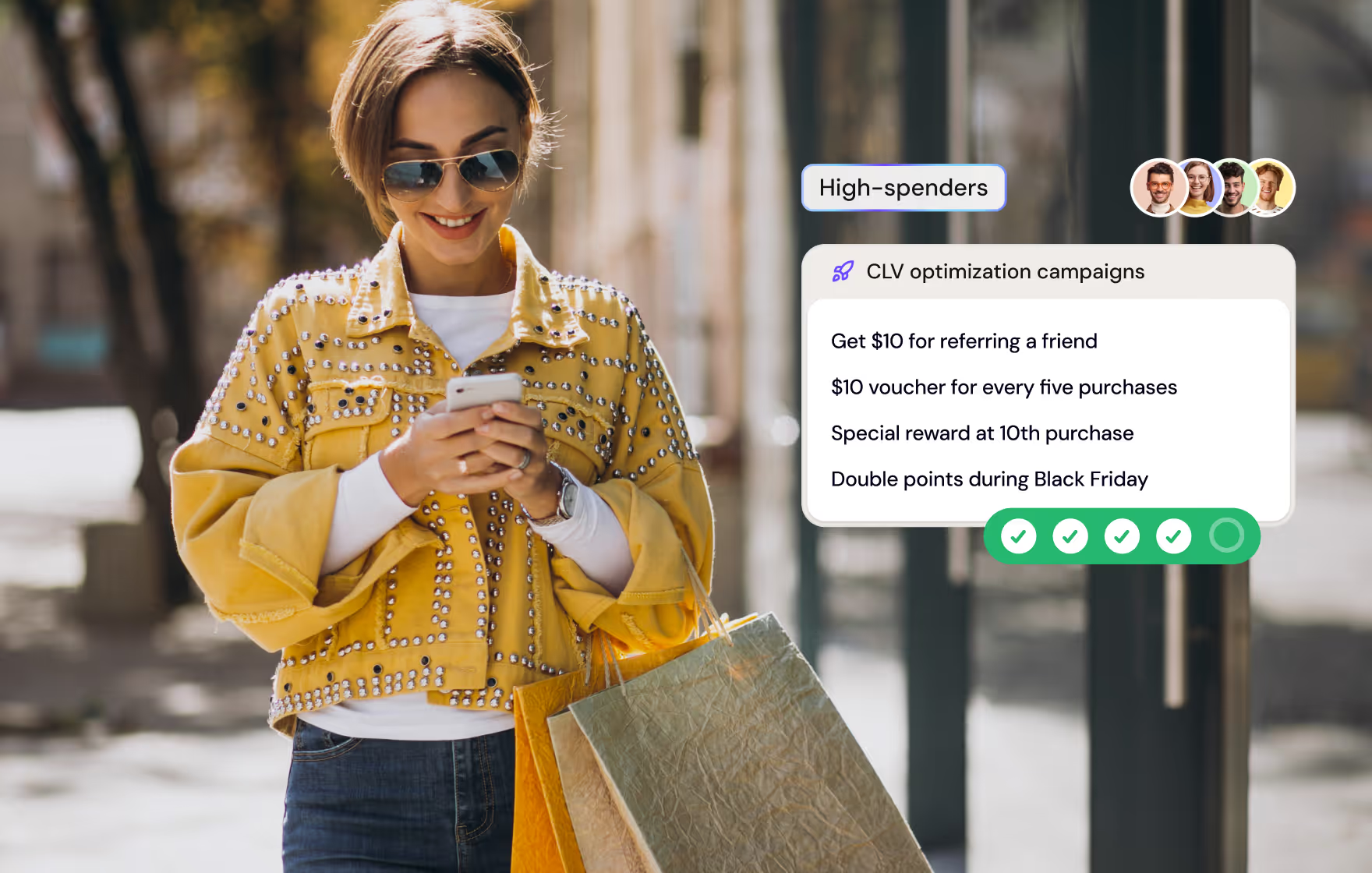
A woman shopping online, in the right Open Loyalty's screen enabling ecommerce conversion loyalty programs

Here's a Q1 tradition. The growth lead opens the dashboard. The average eCommerce conversion rate is stuck in the low 1% range and sliding year over year.

Meanwhile, CAC is climbing. Someone on the call asks: Is loyalty actually a growth lever or a retention line item?.

Short answer: it's both.

The highest-performing eCommerce brands have stopped treating loyalty as a post-purchase thank-you. They're using it as a conversion tool that fires on the product page, in the cart, and at checkout. That's where most traffic quietly disappears, and loyalty has mechanics for every round of that fight.

This piece walks through how. We'll map loyalty mechanics to each funnel stage, spend most of our time on checkout (where most loyalty posts stop short), and finish with measurement, brand examples, and pitfalls.

Why loyalty programs move the conversion needle (not just retention)

Loyalty and retention got bolted together in most marketing playbooks years ago. But retention is a downstream outcome. Conversion is where a loyalty program pays for itself the first time.

Look at the behavior shift. McKinsey's loyalty research shows active program members spend 10% more per transaction than inactive members, and redeemers spend 25% more.

That's not retention data. It's conversion behavior from identified shoppers you can personalize.

Relevance is what moves conversion, which is why 59.7% of loyalty pros are prioritizing personalization in 2026 (per Open Loyalty's software trends data).

Take EQUIVA. Going omnichannel with Open Loyalty at the center, so every touchpoint could trigger automation and personalization, produced a 23% lift in average transaction value and 42% more transactions per customer.

Same shoppers. Different mechanics firing at the right moment.

(Aside on CRM and loyalty: CRM tells you who the customer is. Loyalty tells them why they should care. One without the other is either a very expensive email list or a disconnected points balance.)

Mapping loyalty mechanics to the eCommerce funnel

Every funnel stage has its own conversion problem, and each has a loyalty mechanic that fits. The trick is knowing which fires where.

Stage 1: Visitor to member (signup)

New visitor, first visit, no account. You have maybe twenty seconds of attention before the tab closes.

The job isn't to sell. It's to get them into the program so every future visit has context.

Three mechanics that work. First, an exit-intent signup with instant points (a real reward, not "get our newsletter").

Second, a welcome bonus framed in currency, not points. "$10 off" beats "400 points" every time, because shoppers cannot compute 400 points on the fly.

Third, progressive profiling that collects more data as the member engages. Nobody fills out a twelve-field signup form.

Stage 2: Member to first-time buyer (activation)

Someone with an account but no purchase is the most expensive segment in your CRM.

Two tools do most of the work here. A points head-start paired with a time-boxed welcome coupon (80 points plus 15% off, expiring in 14 days) creates loss aversion.

PDP badges that show earning potential ("Earn 2x points on this") turn a generic product page into a member-only benefit.

For the program models that support this stage, the types of loyalty programs guide has the side-by-side.

Stage 3: First-time to repeat buyer (frequency)

The second order is the highest-impact conversion event in the whole funnel. Repeat customers carry a disproportionate share of revenue across most eCommerce categories, so a program that nudges a second order within the first 30 days compounds faster than almost any paid channel.

Two mechanics pull most of the weight. A visible tier-progress bar on the account page and in the cart ("one more order to reach Silver") gives shoppers a goal to chase.

Bonus-point campaigns on low-margin SKUs subsidize that second order without hitting margin on hero products. For structure, see effective tiered loyalty programs.

Stage 4: Repeat to advocate (referral and VIP)

Most conversion-focused posts skip this stage, but it feeds the top of the funnel again. A repeat buyer who just hit Gold tier is your cheapest acquisition channel.

Open referral codes at tier-up (no form). Drop VIP-only products for the top 5% (the Nike SNKRS playbook). Let status do what discounts can't.

Our referral program guide has the mechanics: automatic code unlocks, two-sided rewards, friend's reward redeemable on the first order.

Checkout-stage loyalty mechanics (the differentiator)

Most loyalty posts stop at "send a thank-you email." The highest-impact conversion work happens one step earlier, at the cart and checkout.

Baymard Institute estimates that roughly $260 billion in recoverable orders are left on the table in the US and EU each year, mostly because of friction and hidden costs.

Loyalty is unusually well-suited to checkout work because it can rewrite the incentive structure without discounting. Six mechanics we see move the needle in over 300 programs, ranked loosely by impact.

Loyalty Mechanics Table
Mechanic Funnel stage Primary effect Expected impact Implementation effort
Pay with points at checkout Checkout Higher CVR (removes payment friction) High Medium
Tier-progress nudge in cart Cart Higher AOV (status motivation) High Low
Abandoned-cart point bonus Cart recovery Recovery without margin erosion Medium Medium
Member pricing visible on PDP PDP Higher signup rate + member CVR Medium Low
Free-shipping threshold tied to tier Cart Higher AOV + repeat rate Medium Low
Spin-to-win / scratch-card at checkout Checkout Impulse CVR on one-time visitors Medium Medium to High

Pay with points at checkout

A toggle that lets members convert points into cart currency reduces the psychological friction of paying.

Money leaving a bank account hurts. Points burning down a balance doesn't.

Our pay with points guide goes deeper, but the effect is clear: members who can redeem at cart complete orders at materially higher rates than members who can't.

Tier-progress nudge in cart

"Add $12 to reach Gold" beats "free shipping over $50" because it bundles an intrinsic reward (status) with an extrinsic one (the next-tier benefit). It also lifts AOV.

On the Open Loyalty + Bloomreach project above, tier-linked prompts contributed to the 23% AOV lift.

Abandoned-cart point bonus

A standard abandoned-cart email offers a discount. A bonus-point offer does the same job without margin erosion.

Points are a liability the brand already accrued, and shoppers don't weigh them the way they weigh "10% off". "Come back in 24 hours and earn 200 bonus points on this order" is the construction.

Member pricing visible on the PDP

Show the guest price with a strike-through next to the member price (not as a banner underneath). The "register to save" moment becomes the "register to convert" moment.

This is the inverse of the "forced registration kills conversion" rule, which only holds when registration adds friction with no benefit.

Free-shipping threshold tied to tier

Everyone has a free-shipping threshold. Tier-linked shipping gives repeat customers a reason to stay logged in, and keeps guests motivated to sign up, because the threshold drops as they progress.

Gold ships free at any cart value; Silver at $30; guests at $75.

Spin-to-win or scratch-card at checkout

A small game of chance creates an impulse moment that generic discounts don't replicate.

Per Open Loyalty's gamification statistics, the market sits at $19.42B in 2025 and is projected to hit $92.5B by 2030 (26% CAGR). Spin-to-win works especially well on one-time visitors (variable reward, zero cost of participation).

Caveat, because we promised no sales pitch: not every mechanic fits every brand. Start with two or three, mapped to the biggest bucket of drop-off in your funnel. Measure. Expand.

How to measure loyalty-driven conversion uplift

If you're pitching loyalty as a conversion lever, measure it like one. A retention-era program reports enrollment and points issued. A conversion-era program reports CVR delta, AOV delta, and incrementality. Five metrics that matter at that intersection:

  • Member vs non-member CVR. Run a cohort comparison or an A/B test at the program or mechanic level. This isolates loyalty's contribution.
  • AOV delta. Members vs guests. If the delta is zero, something in your program design is broken (usually a flat-discount structure overriding progression logic).
  • Repeat purchase rate. eCommerce benchmarks sit around 28%. Members should beat it meaningfully.
  • Redemption rate. The percentage of issued points actually burned. Low redemption means dormant liability, meaning shoppers who don't feel the program. Our redemption rate guide has benchmarks and fixes.
  • Enrollment-to-activation rate. Enrolled members who make a first purchase within 30 days.

One caveat: measure incrementality, not halo. A member converts at a higher rate partly because they were more likely to convert anyway.

The only way to isolate the program's contribution is to run a test cell without access to a given mechanic and compare.

Yes, it's annoying. It's also the only way you'll defend the budget next quarter.

Per Open Loyalty's enterprise loyalty software CLV research, 83% of companies report positive loyalty ROI with an average 5.2x return (7.2x for the top quartile). Those numbers only hold when programs are measured with real test cells.

Three brands that do this well

Sephora Beauty Insider

With 45M+ members, Sephora treats the tier structure as the primary conversion nudge. The "points to next tier" counter sits above the Add-to-Cart button on the PDP.

A shopper who's 300 points from VIB Rouge isn't weighing "should I buy this." They're weighing "should I buy this now, to hit the tier." (More on Sephora's program.)

Starbucks Rewards

The mobile-order flow is the story here. Earn Stars, see them in the app, redeem at mobile checkout in one tap.

Every step converts intent (I want coffee) into completed transaction inside ten seconds. (Full breakdown.)

Nike

With 160M+ active members, SNKRS drops and member-gated releases convert browsers into buyers via artificial scarcity. The conversion happens before the product page loads (being a member is the purchasing moment).

A masterclass in using status, not discount, as the conversion mechanic. (How Nike's program works.)

Common pitfalls that hurt conversion

For every brand running loyalty well, a dozen are running it in ways that quietly hurt conversion.

Over-discounting

Points-as-discount structures with no ceiling erode gross margin and train shoppers to wait for redemption. If your redemption rate is high but AOV on redemption orders is flat, that's the signal.

Simulation of how customers behave when exposed to overdiscounting

Rules complexity

Shoppers bounce when they can't compute the value. "1,250 points for a 15% off coupon on select items excluding sale" is a conversion killer. "100 points = $1" is not.

Fraud dilution

Fraud rings harvest welcome bonuses and abuse referral mechanics at scale. If member margin runs lower than guest margin, fraud is a plausible culprit.

Our loyalty fraud guide has the detection patterns.

Gamification for gamification's sake

A spin-to-win wheel with no conversion goal is a toy. A spin-to-win wheel that triggers on abandonment and awards a time-boxed bonus is a conversion mechanic.

The difference is intent.

Implementation: what the tech stack needs to do

None of the mechanics above work if the stack can't fire them at the right moment. A points balance rendered only in a monthly email does nothing for your cart CVR.

You need an API-first loyalty engine that serves three pieces of state to the storefront in real time: tier, point balance, and redemption eligibility.

Every checkout mechanic depends on that latency being single-digit milliseconds and that data being accurate. If either breaks, members see a stale balance at checkout, and stale balances destroy trust faster than any bug.

MACH and headless loyalty software make this standard. The front-end team renders whatever it wants; the loyalty service just answers targeted questions ("what tier?", "how many points?", "pay with points on this SKU?").

For teams moving off a monolithic platform, our guide to integrating an API-first loyalty engine with your tech stack has the integration patterns.

Fritze von Berswordt, Managing Director at EQUIVA (where this setup drove a 2x lift in buyer frequency):

"We used Open Loyalty pre-built modules, applied the loyalty mechanics via API to our tech stack and focused fully on the customer experience."

That second half is the point. When the platform handles mechanics, the team spends its time on experience, not plumbing.

Verena Pflug, Business Owner at limango, framed the same idea from the shopper side after gamified challenges drove a 41% AOV lift:

"We want to design customer experience so that using the platform feels like playing. By designing challenges for using the platform and implementing mini-games on the website we regularly surprise and delight our customers."

Start at the cart, not the thank-you email

Conversion-era loyalty is a different animal. Done right, conversion-era loyalty looks different in three ways. It triggers at the funnel stages most programs ignore (cart, checkout, PDP). It gets measured against CVR and AOV, not enrollment. And it runs on an API-first stack that can serve member states in real time.

Brands running loyalty this way are getting double-digit AOV lifts and 2x frequency without cutting prices. The ones still treating loyalty as a post-purchase email are subsidizing it.

Pick two checkout mechanics that map to your biggest drop-off. Run them as a test cell for a quarter. Measure member vs non-member CVR. Expand what works.

If you want help mapping these mechanics to your stack, book a 30-minute call with a loyalty architect. Or start wider with our pillar: Best eCommerce loyalty programs: 10 examples + strategy tips.

FAQ

Do loyalty programs actually increase eCommerce conversion rate?

Yes, consistently. Members convert at higher rates than guests because they're identified shoppers you can personalize. 

McKinsey shows active members spend 10% more per transaction than inactive ones, redeemers 25% more. On EQUIVA's omnichannel rollout, AOV rose 23% and transaction frequency 42%. 

Brand-specific projects usually land in the 20% to 40% AOV range when loyalty fires at the cart.

Which loyalty mechanic lifts conversion most at checkout?

Pay-with-points, because it reduces the psychological friction of paying (points burn instead of money leaving an account). 

Tier-progress nudges in the cart come a close second for AOV. Both depend on the loyalty engine serving real-time state to the cart page.

How do loyalty programs reduce cart abandonment?

By changing the incentive at the abandonment moment. A member seeing "earn 2x points on this order" or "add $12 to reach Gold" has reasons to complete that a guest doesn't.

Abandoned-cart point bonuses also work without discounting, which protects margin. Global cart abandonment still sits around 70% industry-wide, and loyalty is one of the few levers that doesn't rely on price cuts.

What's the difference between loyalty for retention and loyalty for conversion?

Retention-era loyalty measures enrollment, points issued, and repeat purchase rate. Conversion-era loyalty measures member vs guest CVR, AOV delta, and incrementality.

Same program, different KPIs. The conversion framing lets growth teams defend loyalty budget with CVR numbers, not soft retention narratives.

How long until we see conversion results?

Checkout-stage mechanics (pay-with-points, tier nudges, bonus-point abandonment offers) show measurable CVR and AOV lift within a quarter, because shoppers in your funnel can use them immediately. Tier progression and referral mechanics take two to three quarters because they need tenure to compound.

Do we need a headless commerce setup to run checkout-stage mechanics?

Not strictly, but it helps. Any stack with a loyalty engine that exposes real-time state via API can run the mechanics.

Headless makes front-end composition easier. Monolithic stacks can still run them; they just feel heavier to change.

Further reading: D2C subscriptions using loyalty to boost revenue.

API-first loyalty and gamification engine

Weekly tips to build & grow gamified loyalty programs
Join Loyalty Builders
About the authors
Deep in SaaS, ecommerce, and AI always rooting for the user (and the reader). Skips the jargon, cuts the fluff, and writes the kind of content that makes you feel smarter, not sold to.
Carlos Oliveira is a seasoned Product Marketing Manager with over seven years of experience in loyalty and gamification strategies.
Join the community
of 4,000 Loyalty Builders!

Get a weekly dose of actionable tips on how to build and grow gamified successful loyalty programs!

Tell us about your challenges and we will together
Disney logo - blackMcDonald's logo - black

Customer loyalty know-how

Leverage resources from Open Loyalty’s gamification and loyalty experts to start smooth and move in the right direction