New
Loyalty Program Benchmark Report 2027: Per-industry statistcs, self-assessment, and more!
Get the report


Most retail loyalty program advice starts with mechanics. Points, tiers, badges, gamification, referrals (pick a few and ship them). That's the wrong place to start, and it's the reason so many customer loyalty programs file quarterly reviews full of "record sign-ups" while the retention curve refuses to budge.
A successful loyalty program starts with a different question: which KPI is each mechanic supposed to lift? Buyer frequency? Customer lifetime value? CAC? AOV?
If your loyalty strategy can't answer that for every feature on the roadmap, your loyalty programs will produce activity, not retention. You'll have engaged loyalty members, growing point balances, healthy email opens, and a cohort curve that overlaps perfectly with non-members.
If you've sat through a stakeholder review where "record sign-ups" couldn't explain why retention wasn't moving, this one's for you.
Below: seven mechanics for retail loyalty programs that actually retain customers (not just attract them), each paired with the KPI it's supposed to move, each backed by real numbers from one of the best retail loyalty programs in the European market (limango, EQUIVA, ALDO, Henkel).
Plus, a closing implementation move you can ship next quarter without rebuilding the tech stack. No "top 10 ideas" fluff. No loyalty programs theater dressed up as strategy.
A 5% increase in customer retention correlates with a profit increase of 25% to 95%, a stat that has been quoted in every loyalty deck for two decades because it keeps holding up.
What has changed is the cost of the alternative. Customer acquisition costs have risen 222% since 2013, paid CAC is up another 7% in retail since 2023, and 84% of consumers say they're more likely to stick with a brand that runs a loyalty program. For increasing customer retention, repeat purchases from existing members are now cheaper to produce than first purchases from strangers.
Members of loyalty programs spend 39% more per transaction than non-members. Active members of a rewards program spend 10% more than inactive members; customers who redeem points spend 25% more. Two-thirds (66%) of loyalty program members report spending more on a brand to maximize points.
Not vanity numbers. They're the buyer frequency, repeat purchases, and AOV lifts that a well-designed retail loyalty program is supposed to produce among your most valuable customers. And one number that should keep retail CRM teams up at night: roughly 70% of retailers fail at omnichannel loyalty programs. More on that in Way 6.
Right, so how do you actually do this?
Many retail loyalty content treats the seven (or ten, or fifteen) "ways to build customer loyalty" as a buffet. Pick a few, mix and match, hope for the best. That works for a single-store coffee shop. It doesn't work for retail customer loyalty programs operating across channels and markets, with tens of millions of euros in annual revenue.
The structural move that works: every mechanic in your customer loyalty programs must be paired with the specific retention KPI it's designed to lift.
A points-based loyalty program with no frequency target is a punch card. Tier-based loyalty programs without a customer lifetime value thesis are gym memberships that people forget they joined. Gamification without a target behavior is decoration. You get it, right?
The job of well-designed loyalty programs is to make every feature on the roadmap accountable to a number. Get the pairing right and customer engagement compounds, repeat purchases climb, and you retain customers who would otherwise have churned.
Loyalty programs that work at scale are the ones where every mechanic answers a metric.
Here's the map, condensed:
Each section below leads with the KPI, not the mechanic. That is the order to consider when designing retail loyalty programs.
KPI moved: Buyer frequency. Secondary: AOV.
A points-based loyalty program is the most common type of customer loyalty program in retail, and also the most commonly mis-designed.
The failure mode is almost always the same: the time-to-first-reward is too long. Members earn points at a glacial pace, calculate they're 12 purchases away from anything tangible, and stop checking the app. By month six, the loyalty program members who were supposed to be your most engaged loyal customers are indistinguishable from the churn cohort.
The fix is engineering. Points-based loyalty programs work when the earn-and-burn cycle is short enough to feel achievable within two or three typical purchase cycles.
That is a design decision before it is a marketing decision.
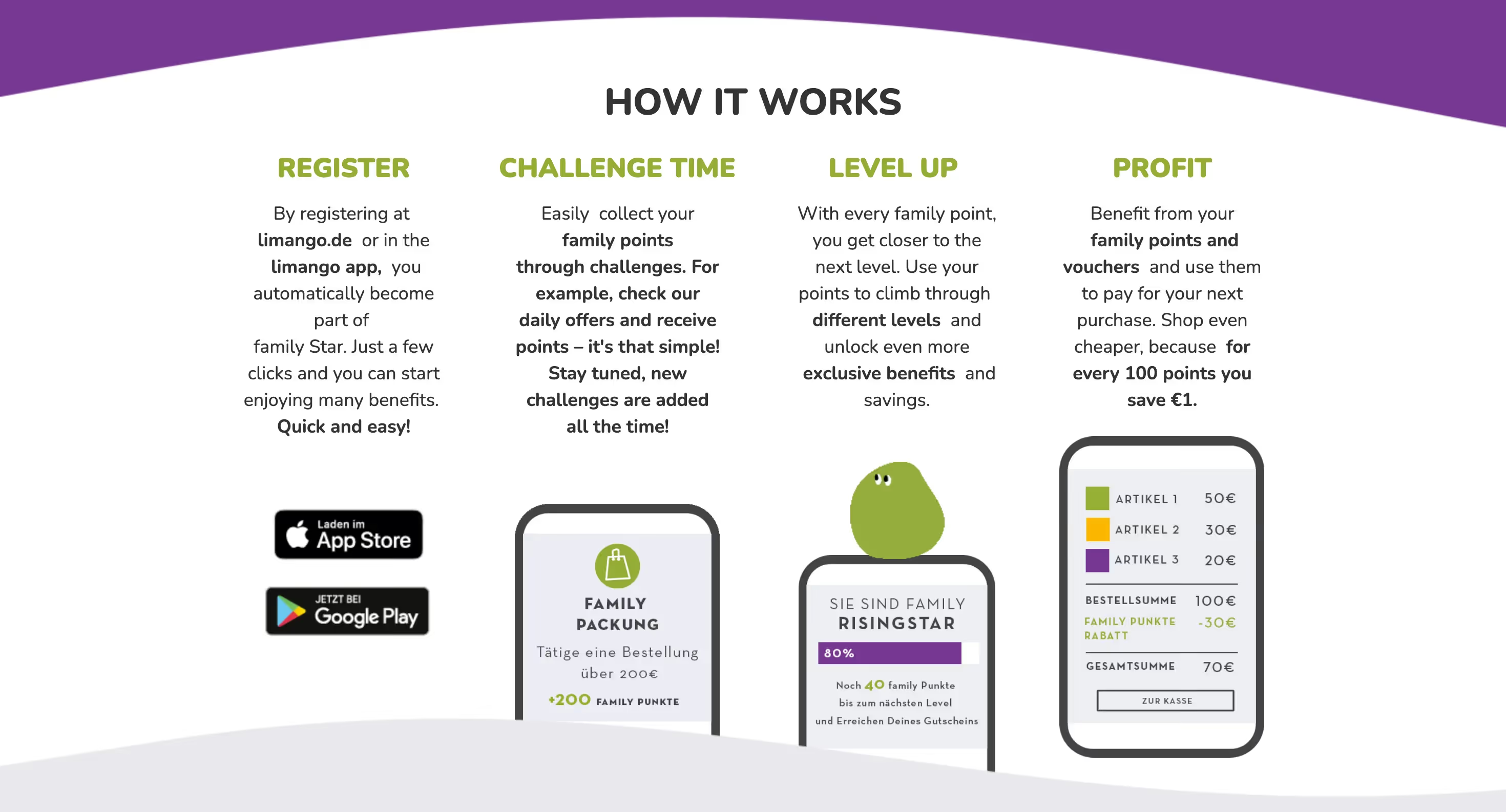
limango, a member of the Otto Group with 22 million members across four European markets, runs its family Star program on a tangibility rule. Customers earn points on every purchase. One hundred family points equal €1 of family credit, and members can redeem points alongside vouchers on the same order. No mental arithmetic required.
Starbucks Rewards (34.6 million 90-day active members in the US as of 2025) builds a ladder from 25 Stars (a drink customization) to 400 Stars (merchandise), so members hit a reward early and aspire to a bigger one later.
The best points-based loyalty programs share that structure: achievable milestones at the bottom of the loyalty tiers, aspirational rewards at the top, and a clear path to repeat purchases between.
If you take one thing from Way 1: when you design a points-based loyalty program, design the first reward first. The first €5 voucher has to feel reachable. Platinum can stay aspirational. That's how loyalty programs encourage customers to come back inside two or three weeks instead of two or three months.
KPI moved: Customer lifetime value. Secondary: Retention rate.
Tier-based loyalty programs work because of a quiet psychological lever that loyalty marketing decks underplay: loss aversion.
Members do not just spend to reach the next tier. They spend to protect the tier they already have. Once a customer has reached Gold, dropping back to Silver is more motivating than reaching Platinum. The retention behavior is defensive, not aspirational.
That has a design implication retailers often miss. Lifetime tier qualification removes the loss-aversion lever. Time-bounded tier qualification keeps loyalty tiers sharp. The members who hit Gold in Q1 spend in Q4 to stay there.
ALDO Crew, the global rewards program from the footwear brand, runs spending-based loyalty tiers on a 12-month rolling cycle across the US, UK, and Canada.
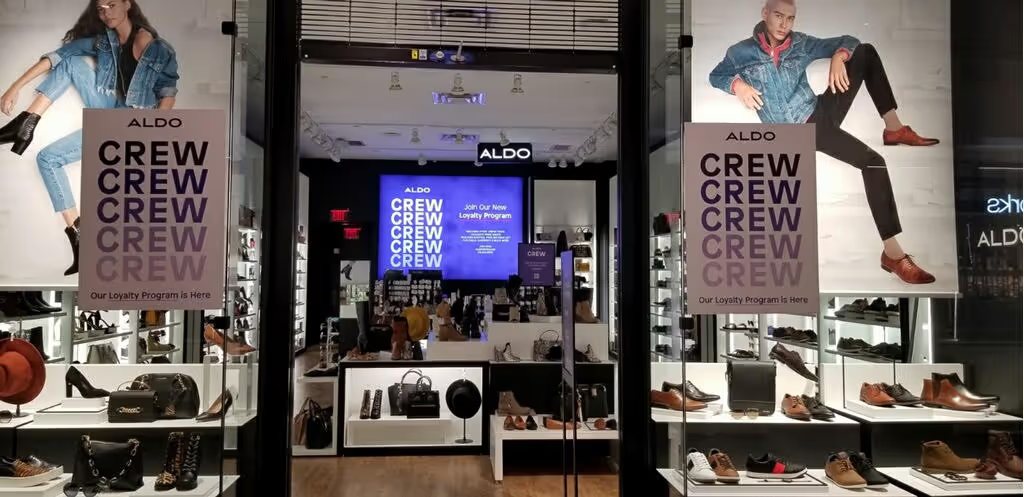
Tier 2 unlocks free shipping over $50 and exclusive discounts of 15%; Tier 3 adds a 20% voucher, exclusive access to private sale windows, and the ability to share the discount with up to five friends. Members must hit the spending threshold within a rolling 12 months or they're downgraded.
That downgrade pressure is what keeps the loyalty program working as a retention engine instead of a one-time status play. Higher-tier members also unlock exclusive access to early product drops. Exclusive perks scale with tier, which is what motivates the next dollar of spend.
EQUIVA, the German home goods retailer, made an even smaller choice that turned out to be one of its smartest. The three tiers in the EQUIVA Friends program are named Friend, Best Friend, and Soulmate. Not Bronze, Silver, Gold. Relational language, not competitive language. Top-tier members get up to 10% off every purchase, plus access to exclusive events with seasonal partners. The benefit ladder is conventional. The emotional positioning is not.
Sephora's Beauty Insider ladder (more than 45 million loyalty members) is the canonical best-in-class example of a customer loyalty program. It uses rolling-window qualification, makes tier benefits visible inside the experience, and treats tier status as the most valuable thing the member owns.
For a fuller breakdown of when to use spending tiers versus engagement tiers in tiered loyalty programs, see Open Loyalty's guide to effective tiered loyalty programs.
KPI moved: Buyer frequency. Secondary: Redemption rate.
Gamification is the highest-leverage retention mechanic of 2026, which is also why it's the most-abused one. The trap is decorative gamification: a spin-the-wheel widget with no behavioral trigger, a streak counter nobody understands, a badge for "logging in five times." These produce customer engagement metrics that go up and retention metrics that don't move.
Gamification only works when the challenge is anchored to a specific behavior. A second purchase. A cross-category trial. An in-store visit. A product review. The mechanic is a means to an end (the behavior), not an end in itself (the badge).
limango is the cleanest case. Inside its rewards program, the team built a "purchase frequency challenge" segmented by historical member behavior. Purchase frequency moved from 2.5 purchases per three-month period in 2023 to 7.8 in 2024. A separate challenge built for customers with an AOV below €100 raised the average order value to €93, a 41% lift.
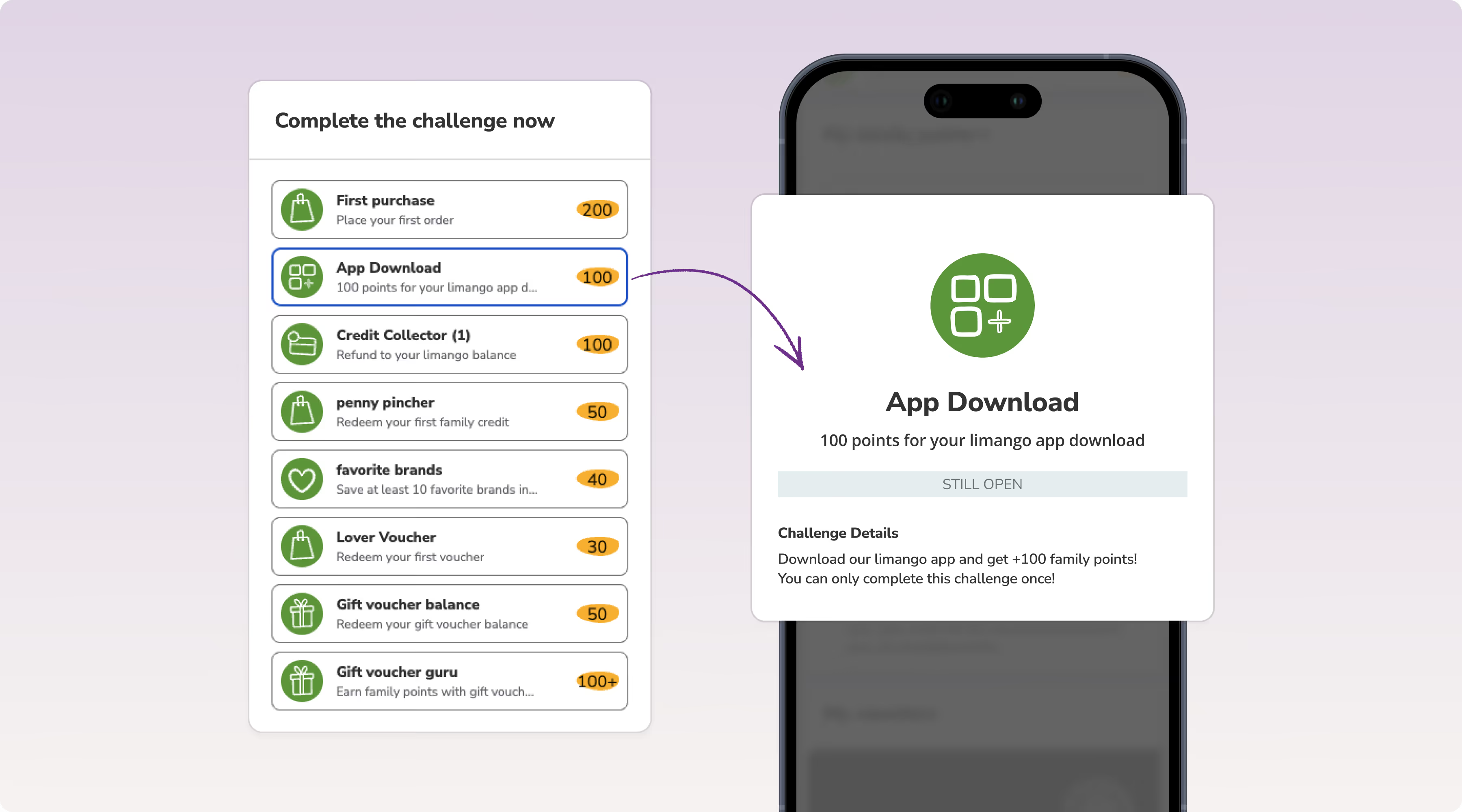
Other limango challenges run on cultural triggers, time-of-day triggers ("early bird" rewards for morning shopping), and seasonal triggers. None are decorative. Each targets a measurable behavior in the loyalty programs ecosystem.
In Open Loyalty's most recent trends report, 42.1% of loyalty professionals ranked gamification as a top medium-term mechanic for their loyalty programs. Lidl Plus uses a coupon-scratch mechanic that drops rewards into the app coupon section, collapsing the gap between earning and redeeming. Both are bets that customer engagement compounds when the loyalty programs feel fun.
If you're adding gamification to your retail loyalty program, the test question is simple: which behavior is this challenge supposed to produce? If you don't have a one-sentence answer, the challenge is decoration.
Open Loyalty's challenges, badges, leaderboard software, games of chance, and customer gamification software are the building blocks behind limango's challenge library.
KPI moved: Customer acquisition cost. Secondary: CLV of the referred cohort.
This is the retention angle most retail loyalty content misses. Referred customers retain at 15% to 25% higher rates than paid-acquisition new customers.
So a referral program inside customer loyalty programs is doing two retention jobs at once: it reactivates the referrer and it imports a higher-retention cohort of new loyal customers. The referral mechanic is a CAC lever and a CLV lever in the same line of code.
The design move that matters most: reward both sides asymmetrically. The referred friend gets the bigger upfront incentive at registration. The referrer gets a delayed reward conditioned on the new customer's first purchase.
That stops the gaming, weeds out throwaway accounts, and ties the referrer's payoff to actual revenue. The program ends up rewarding members for genuine advocacy instead of clicks.
EQUIVA's referral mechanic ran exactly this play. Referred friends received a meaningful welcome reward upfront. Referrers earned additional "Hearts" (the program's points unit) only when the referred friend completed a purchase. By February 2025, more than 12,000 referred customers had been brought in, generating roughly €240,000 in saved CAC.
limango runs a similar asymmetry: a €15 welcome voucher to the referred friend at registration, a €10 voucher to the referrer only after the new member's first purchase. Small enough to protect unit economics, big enough to actually move someone to click the link.
A retail customer loyalty program without a referral mechanic is leaving acquisition spend on the table. Build it as a referral program software layer on the points-based loyalty program, condition the referrer reward on a real purchase, and the math takes care of itself.
KPI moved: Average order value. Secondary: Redemption rate.
Personalization is the most-cited gap in retail loyalty programs heading into 2026 (59.7% of loyalty professionals ranked it a top priority). It is also the most-abused word in the category.
Sending a "Hi {{first_name}}" subject line is not personalization. Adding the member's tier name to the footer of an email is not personalization. Those are template merges.
Personalization that moves AOV is segment-level offer triggering on behavioral signals.
Different bonus point events for members below and above a certain AOV. Different category bonuses for members who haven't purchased in 60 days versus members who buy every two weeks. Personalized rewards keyed to purchase history. Personalized benefits triggered by customer behavior, not by calendar. The mechanic is segmentation plus per-session offer logic, fed by clean customer data, not personalization in the abstract.
That's the part that breaks legacy stacks. A loyalty engine applying offer rules in overnight batch jobs can't do real-time, per-cart personalization. The prerequisite is an API-first architecture where the loyalty layer responds to cart events, not just closed transactions.
limango's bonus point events ran exactly this way: triggered at the cart level on behavioral segments rather than broadcast to the whole member base. The 41% AOV increase came out of that segmented design. The targeting was load-bearing.
Henkel Italy's Dfamily program runs personalization on zero-party data collected through 13 branded surveys. The segmentation input matters as much as the output. For a structured way to think about who to segment, see Open Loyalty's loyalty segmentation guide.
KPI moved: Retention rate. Secondary: Buyer frequency.
Multi-channel customers spend four times as much as store-only customers and ten times more than digital-only customers. And yet most retail loyalty programs only reward closed purchases, leaving the highest-value behaviors (cross-channel browsing, app activity, in-store visits, reviews) entirely unrewarded.
Omnichannel milestone rewards are the fix. Award points or unlock tier-bound benefits for the behaviors that signal multi-channel engagement, not just transaction value. A first in-store visit after an online purchase. An app session with a barcode scan. A product review with photos. These behaviors correlate with retention, and loyalty programs should pay for them.
The prerequisite is harder than it sounds: a unified member profile that updates in real time across every touchpoint. Where 70% of retailers fail at omnichannel loyalty is the data layer. They build channel parity with overnight batch jobs instead of real-time sync, and the gap between systems quietly becomes a gap in the member experience.
A member who earns points in-store at 11 am but doesn't see them in the app until tomorrow is experiencing two disconnected loyalty programs.
ALDO Crew is the case to study. The program launched in three countries in three months. It runs fully omnichannel on the same engine, with no physical card (members identify with a phone number), and handles 1,500 concurrent API calls with sub-one-second response time. The unification is an actual unified profile updated synchronously, not just marketing language.
EQUIVA's omnichannel data is the financial proof. By February 2025, 82% of EQUIVA's business will go through the loyalty program. After moving from a paper sticker card to an omnichannel app: 30% YoY increase in average annual revenue per customer, 21% increase in physical store visits, 14% growth in "Max Share of Wallet" customers spending more than 50% of their €1,000+ category budget with EQUIVA.
For a broader treatment, see omnichaonnel retail loyalty programs in 2026.
Open Loyalty's customer retention software, loyalty card system, and multitenancy are the mechanics behind ALDO and EQUIVA.
KPI moved: Retention rate over the long horizon. Secondary: Brand advocacy.
This is the long-game retention play, and the one that separates a retail loyalty program with a two-year shelf life from one that compounds. Over 50% of memberships in purely transactional loyalty programs eventually go inactive. Emotionally engaged customers are 82% more likely to remain loyal; companies that excel at personalization generate 40% more revenue.
The direction is consistent across studies: a program that competes purely on discount math eventually loses to one that doesn't. Emotional engagement turns customer loyalty programs into brand loyalty drivers.
Layer experiential rewards on top of the transactional core. Early access. Exclusive events. Sustainability commitments. Status recognition. Community access. Birthday surprises that aren't just a 10% off voucher. These are the experiential rewards that make loyalty programs feel like a membership program instead of a punch card.
EQUIVA's founder put it in a single quote:
"We wanted to create an emotional relationship with all our customers. We decided to move from competition-like tiers, e.g. bronze, silver, gold and instead refer to our customers as friends, best friends, and ultimately soulmates."
Naming is one of the cheapest design decisions a brand can make. EQUIVA's is also one of the most consequential.
Henkel Italy's Dfamily takes the same idea to a more content-heavy place. The program shares brand values alongside transactional rewards, with content like "how to wash your jeans sustainably." The Henkel CRM, Digital and Tech Manager framed it:
"A loyalty program is a great initiative for CRM and customer retention. Once you connect with a consumer, you can stay in touch. A loyalty program helps go beyond promotions by offering something of real value."
That last clause is the whole brand loyalty argument.
IKEA Family (150 million+ members globally) offers a layered version: discounts, birthday surprises and complimentary hot drinks at every store visit. The drink is the emotional layer. The discount is the transactional layer.
Three patterns we see often enough in retail loyalty programs that they're almost a checklist of what not to do.
Loyalty program sign ups, points balances, and email opens are activity metrics. They tell you the program is alive. They don't tell you anyone is being retained. The honest answer comes from a same-cohort retention curve over 12 months. If the curves overlap, the loyalty programs are labeling, not retaining.
Points here, a referral campaign there, a gamification widget on top. Each ships independently. None shares a member profile or a real-time event stream. Six months later, the team is debugging why the same customer has different point balances in three places.
The most successful loyalty programs treat the seven mechanics as a system, not a stack.
The most expensive failure mode in 2026. Teams invest in personalization tools and use them to vary the subject line of a broadcast email. That's segmentation theater. Personalization that moves AOV in loyalty programs requires per-session offer logic on behavioral segments.
The marketing team can't fix that. The platform has to support it.
The mistake most retail teams make after reading a "7 ways" post is trying to deploy all seven mechanics at once. That produces a roadmap nobody can ship.
The better play: pick two. The ones that move the KPI your CFO cares about this quarter. CAC if acquisition is bleeding. CLV if retention is the executive's ask. AOV if margin is the pressure point.
Build a test cell. Run it for a quarter. Measure against that KPI, not against activity metrics inside the loyalty program. Decide whether to scale, kill, or iterate. That iteration loop is how the best loyalty programs compound.
Each of the seven mechanics asks for something different from the platform underneath, and a loyalty engine optimized for any one of them usually compromises on the others. Open Loyalty exposes every loyalty event as a discrete API call, which is why retail teams can combine the seven without rebuilding the core.
If you're scoping a retail loyalty program (or rebuilding one of those loyalty programs that hasn't moved retention or repeat purchases), talk to the Open Loyalty team. Bring the KPI you're trying to move and the two mechanics you're considering. The conversation is faster when the scope is that specific.
A retail loyalty program is a structured marketing strategy that rewards customers for repeat purchases, engagement, and other defined behaviors at a retail brand. Retail loyalty programs can be points-based, tier-based, paid (subscription-based loyalty programs), value-based, or some combination. A retail customer loyalty program is built to lift retention KPIs (buyer frequency, CLV, retention rate) by giving members reasons to come back beyond the next discount, plus the data infrastructure to act on customer preferences over time.
A points-based loyalty program lets customers earn points redeemable for discounts, rewards, or free products. The mechanic moves buyer frequency. A tier-based program ranks members into levels with escalating exclusive benefits, designed to motivate spend to reach (and protect) higher tiers. The mechanic moves customer lifetime value.
A paid loyalty program (one of the subscription-based loyalty programs) charges members a monthly or annual fee for exclusive benefits (Amazon Prime is the canonical example, Costco the most extreme at a 92.9% renewal rate). A value-based loyalty program aligns rewards with the customer's personal values (sustainability, ethics, craft) rather than purely financial incentives. Most high-performing retail loyalty programs combine two or three of these.
There is no single best type. The right design depends on the KPI the program is supposed to lift, which makes the question really about loyalty strategy, not template choice. Points-based loyalty programs lift buyer frequency when the earn-and-burn cycle is short. Tier-based loyalty programs lift CLV when tier qualification is time-bounded.
Paid loyalty programs lift retention through commitment but require a benefits package strong enough to justify the fee. A value-based loyalty program works in categories where customers care about what the brand stands for. The answer for a given retailer is usually a combination of loyalty program mechanics, not a single template.
On a configurable, API-first platform, a mid-market retail launch can ship in 8 to 16 weeks. On an enterprise SaaS suite with a multi-year implementation contract, the same launch takes 12 to 24 months.
ALDO launched a fully omnichannel rewards program across three countries in three months on Open Loyalty. EQUIVA replaced a legacy paper-card program in under four months. Time-to-value is one of the most underrated selection criteria for the best retail loyalty programs.
Track key metrics that map to the retention KPI you designed each mechanic to move, not the activity metrics inside the program. Sign-ups, points balances, and email opens tell you the program is alive. Buyer frequency, AOV, CLV, CAC, and retention rate (members versus a matched non-member control group) tell you it's working.
The single most useful comparison is the same-cohort retention curve over 12 months. If members don't retain at a materially higher rate, the loyalty program isn't retaining anyone, it's just labeling people who would have come back anyway.
Two places, mostly. First, AI and machine learning models help retail teams understand customer behavior, predict which members are about to lapse, and surface which offers are likely to convert. Second, AI tools turn the customer data loyalty programs collect (purchase patterns, channel preferences, redemption behavior) into segment-level recommendations.
The constraint is the data architecture underneath. AI-driven personalization is only as good as the segmentation inputs and the real-time sync between the loyalty engine and the activation layer. AI doesn't fix a fragmented stack. It exposes one.
Yes, but the mechanic mix shifts. Points-based loyalty programs underperform in low-frequency categories (furniture, appliances, jewelry) because members do not reach reward thresholds. Tiered loyalty programs work better because they reward total spend over a long horizon.
Referral mechanics are especially strong because the AOV is high enough to justify a meaningful referrer reward. The EQUIVA case study shows that, for low-frequency retail loyalty programs, 82% of revenue runs through the program despite an average transaction in the hundreds of euros.

API-first loyalty and gamification engine

Get a weekly dose of actionable tips on how to build and grow gamified successful loyalty programs!